Early Action vs. Early Decision
Compare early action, early decision, and restrictive early action, then choose a college application plan based on readiness, fit, and affordability.

Early action lets you apply earlier without promising to enroll. Early decision asks you to make that commitment if admitted, subject to the college's agreement and financial aid process. The difference is not just when you hear back: it is how much freedom you keep after receiving an offer.
Before selecting an application plan, answer three questions: Is this college truly your first choice? Is your application ready? Does your family understand the likely cost? An earlier deadline is useful only when the plan fits your answers.
Understand The Three Early Plans
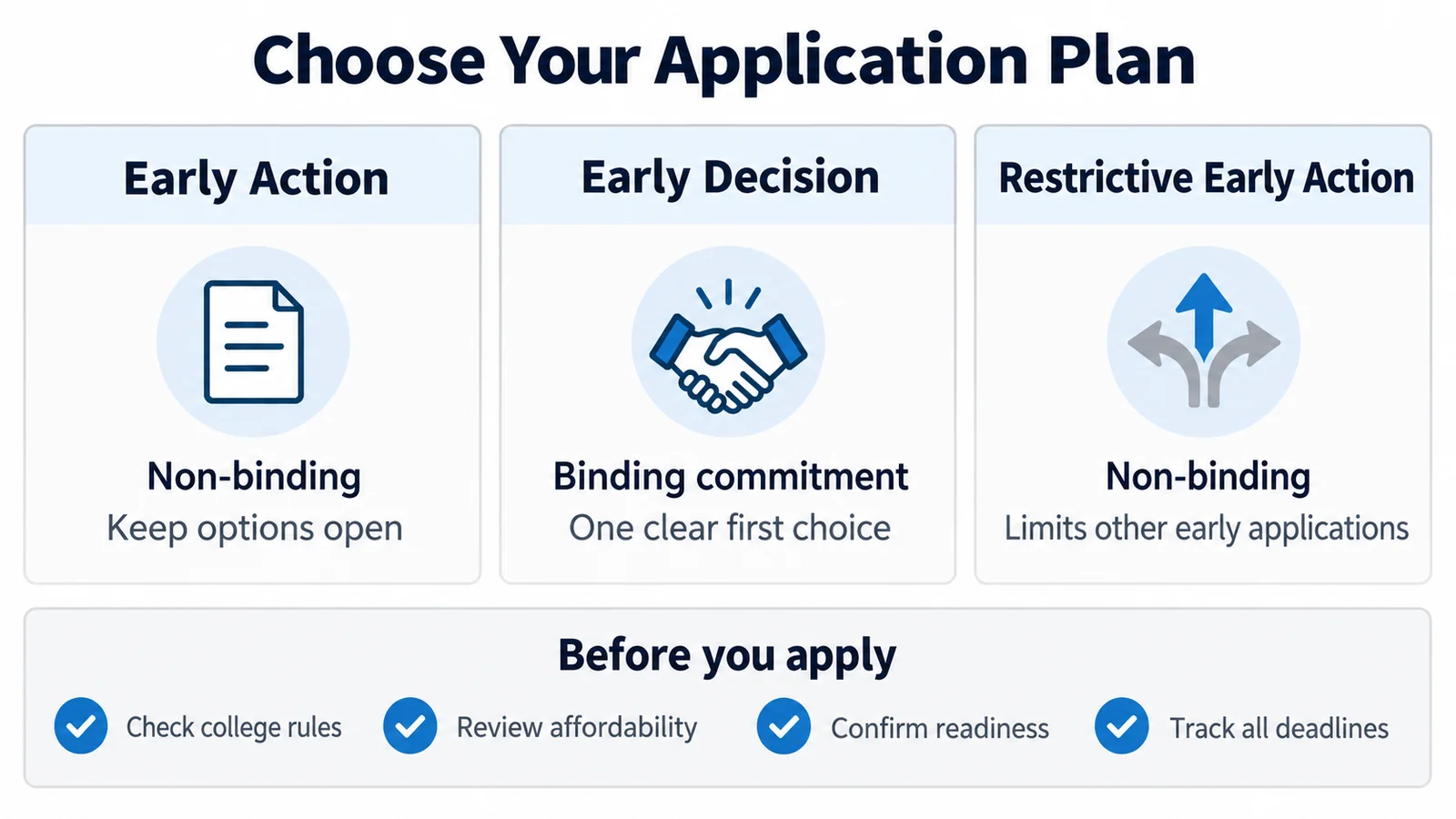
Early action (EA) is non-binding. You apply by an earlier deadline and receive a decision before the college's regular notification date. You can keep considering other schools rather than committing immediately.
Early decision (ED) is binding: you apply to a first-choice college intending to enroll if admitted and withdraw other applications as required by the agreement. Read the financial aid provisions before signing. It is not a way to reserve a place while continuing to shop for offers.
Restrictive or single-choice early action (REA or SCEA) is non-binding but limits other early applications. The restrictions vary by college, so do not assume every plan containing the words “early action” works the same way.
NACAC's Guide to Ethical Practice distinguishes these plans and recommends that non-binding applicants have until at least May 1 to respond. Check the actual reply deadline in each college's offer.
Read Each College's Rules Before Combining Applications
Build your plan from official admissions pages, not a friend's application list. For example, Yale's single-choice early action policy is non-binding but generally restricts other early applications. Its listed exceptions include non-binding public-college early programs and non-binding rolling admission. Read the complete exception list before deciding whether another application is allowed.
That example illustrates why “non-binding” does not mean “unrestricted.” Save the policy page for every restrictive plan you are considering. If two policies seem incompatible, ask the admissions offices and your counselor before submitting either application.
For ED, keep only one pending binding application at a time. Common App's guiding principles recognize both ED I and ED II, but the second round is not permission to hold two simultaneous ED commitments. ED II is a later binding round, not a non-binding alternative. Confirm that any earlier commitment is resolved before using it.
Make Affordability Part Of The Decision
Imagine you like two colleges about equally, and your family needs to compare their aid offers. A binding application would conflict with that goal. Non-binding options let you make the comparison before choosing where to enroll.
Before considering ED, use the college's net price calculator with your family and save the inputs and estimate. Treat it as a planning estimate, not an aid award. Ask the financial aid office about circumstances the calculator may not capture, and check whether it is designed for your applicant situation.
Then discuss an actual budget. What can your family contribute each year? What would remain after grants and scholarships? How much borrowing, if any, are you willing to consider? Do not substitute the college's advertised tuition for your full cost of attendance.
Duke's financial aid guidance explicitly notes that ED applicants will not have the opportunity to compare its aid and scholarships with offers from other schools. Its admissions FAQ explains that students who ultimately cannot afford attendance may be released after discussions with the family, financial support office, and admissions office.
If an ED aid offer is unaffordable, contact those offices promptly, explain the gap, and follow the college's review and release process. Do not simply ignore the agreement. NACAC recommends release when aid does not make attendance possible, but its guide is a professional recommendation; your college must explain how its process works.
Check Whether Your Application Is Ready
Being ready means more than having an account and a nearly finished essay. Review your application as a complete package: coursework, activities, writing, recommendations, and any required testing or supplements.
Consider two hypothetical students. Maya has a clear first-choice college, polished essays, and a family that has reviewed the cost estimate. ED may be worth discussing with her counselor. Jordan is still comparing programs and needs more time to revise. EA, if the materials are ready and the rules permit it, or regular decision may fit better.
Neither student needs to choose an early plan just because classmates are doing so. Ask what would meaningfully improve before the later deadline. A clearer essay or completed portfolio is a concrete reason to consider waiting; vague hopes that everything will somehow look better are not a plan.
Set aside one focused session to list what is finished, what needs revision, and what depends on someone else. Recommendations and school records require coordination, so confirm your school's internal request deadlines too.

Use A Four-Part Application-Plan Checklist
Work through this checklist for each college instead of assigning one plan to your entire list:
- Check college rules. Record the available plans, whether each is binding, and any limits on other applications. Save the official policy link.
- Review affordability. Discuss the estimate and your budget. Decide whether comparing multiple actual aid offers is necessary before committing.
- Confirm readiness. List unfinished essays, recommendations, transcripts, tests, or portfolio items. Give each an owner and a realistic completion date.
- Track all deadlines. Record application, supporting-material, financial aid, scholarship, and reply dates separately. Verify the entry year and any stated time zone.
Add a short explanation next to your choice: “EA because my materials are ready and I want to compare offers,” or “Regular decision because my portfolio needs another month.” If the explanation is only “better odds,” revisit the decision.
An overall early admit rate is not your personal probability of admission. It does not establish that submitting the same application earlier would change your result. Yale, for example, states on its first-year application page that it does not advantage students based on application program. Avoid treating a binding commitment as an admissions guarantee.
ColleGPT from The College App can help organize questions about application plans and deadlines. Use those questions to guide your research, then verify the answers on each college's current admissions and financial aid pages.
Keep Working Until You Have A Clear Outcome
Do not stop preparing other permitted applications while waiting for an early decision. Keep drafts and materials moving so an unfavorable result does not leave you scrambling.
If admitted under a non-binding plan, note the reply deadline and continue comparing your options. If admitted under ED, review the offer and aid information and follow the agreement's enrollment and withdrawal instructions. If deferred, read the college's directions about continued consideration and allowed updates; do not assume the next step is identical everywhere.
Your next move is small: open the official admissions page for one college, write down its plan rules, and discuss readiness and affordability with your family or counselor. Choose the plan you can explain and honor—not simply the earliest button on the application.