How to Find Colleges That Offer Your Major
Find colleges by major, verify degree requirements and entry rules, and build a shortlist using official program pages and College Scorecard.

To find colleges that offer your major, start with a broad search tool, then verify each result on the college's own program page and undergraduate catalog. A school appearing in a search result is a lead, not proof that it offers the exact degree, campus experience, or entry route you want.
Your goal is a short list of programs you can explain: what you would study, how you would enter the major, and why the coursework interests you. Here is a practical way to get there without opening dozens of tabs you never revisit.
Start With Subjects, Not Just One Major Name
Write down your preferred subject and a few related search terms. Colleges do not always organize similar interests under identical program names. Someone interested in protecting rivers might investigate environmental science, ecology, environmental engineering, and environmental policy. Those are possibilities to compare, not interchangeable degrees.
Next, write one sentence about the work you want to do. For example: “I want to collect water samples and understand pollution,” or “I want to help communities write better environmental rules.” Those interests may point toward different required courses even when program descriptions sound similar.
If you are undecided, choose two or three subject areas to investigate. You do not need to settle on a lifelong career before searching. You do need enough direction to recognize a program worth reading about.
Use College Scorecard To Discover Options
College Scorecard is a useful starting point for exploring colleges and field-of-study information. Federal Student Aid's official Scorecard update describes its institution comparisons and field-of-study outcome searches. Use it to discover options and add context, then verify current offerings directly with each school.
Keep your intended degree level in view. A certificate, associate degree, bachelor's degree, and graduate degree are different search targets. If you want a bachelor's program after high school, finding a university's graduate department is not enough.
Try your main subject first, then related terms if the results are sparse. Avoid applying every preference at once. Narrowing immediately to one city and one exact program name can hide useful possibilities. Save a manageable first batch of schools and move to their official sites.
Treat outcome figures as context rather than promises about your own future. Do not mistake a school-wide number for the result of one specific major, or let one number replace a close look at the curriculum.
Verify Each Program With A Five-Step Check
For every potential school, open its undergraduate majors list, program page, and current catalog. Search within the official site if the navigation is confusing. A query such as “college name environmental science undergraduate catalog” can be more useful than another general ranking list.
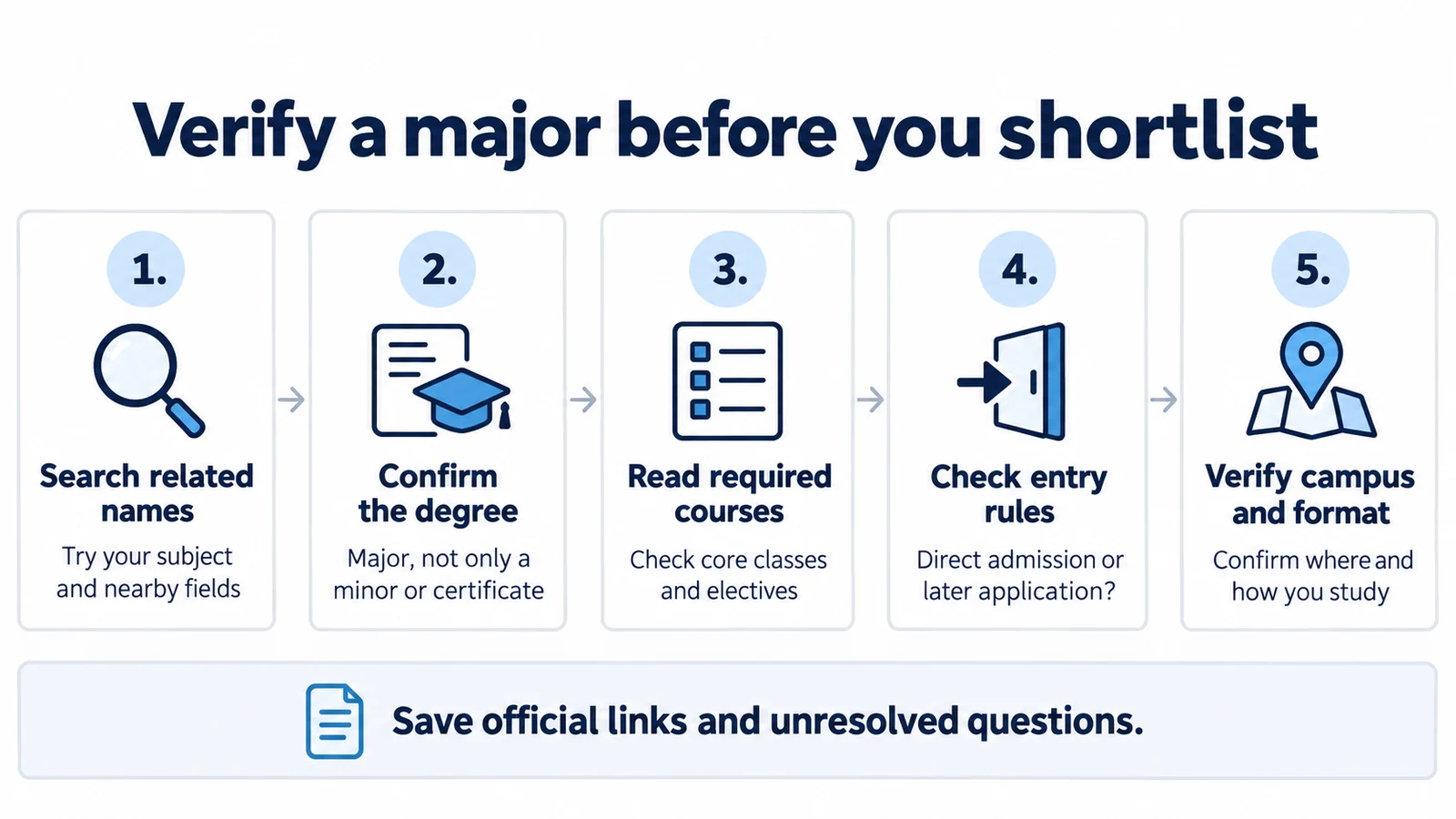
Use this same checklist each time:
- Search related names. Check whether your interest lives under a different department or broader major.
- Confirm the degree. Make sure it is an undergraduate major, not only a minor, certificate, concentration, or graduate offering.
- Read required courses. Look at the core sequence and electives, not just the promotional introduction.
- Check entry rules. Determine whether students enter directly or apply to the major after enrolling.
- Verify campus and format. Confirm where the program runs and whether it is in person, online, or a combination.
Save the official links and any unresolved questions. Mark a school “needs confirmation” when something is unclear instead of filling the gap with an assumption.
Read The Courses You Would Actually Take
Two appealing program names can lead to very different weeks of classes. Read the first-year plan and several advanced requirements. Ask which courses you would be excited to take and which would require preparation you have not considered.
For a concrete example, Oregon State's environmental sciences catalog describes a bachelor's program combining biological, physical, and social sciences. It lists basic science and math, an environmental sciences core, a specialization, and experiential learning. That tells you more about the work involved than the major's name alone.
A student drawn to environmental policy should therefore read both the specialization choices and the shared science requirements. A student excited about fieldwork should investigate how experiential learning is arranged. Neither should assume that every course or opportunity is available in every format.
Look beyond classrooms, too. For a lab-based interest, ask how undergraduates access teaching labs and research opportunities. For other subjects, investigate studios, field courses, performances, internships, or community projects. A photograph of impressive facilities does not tell you when students actually use them.

Separate Program Availability From Admission
“Offers my major” and “I can enter that major” are separate questions. Read the admissions section for your applicant type and intended start term. Do not apply transfer requirements to a first-year application or assume university admission settles every program requirement.
Purdue's computer science program page, for example, identifies the Bachelor of Science and its locations, links to a plan of study, and includes a distinct transfer section. That structure is a useful reminder to read the correct part of an official page rather than copying the first GPA requirement you see.
For each school, find answers to these questions:
- Do I apply directly to the major, a broader academic division, or the university?
- Is a later application, prerequisite sequence, audition, or portfolio required?
- If I enroll undecided, what is the process for entering this major?
- If I change my mind, what rules govern moving to another program?
If the website does not answer clearly, contact admissions or the department. Ask a precise question: “As a first-year applicant interested in this major, would I enter it immediately, or complete a separate selection process later?” Keep the answer with your research notes.
Build A Shortlist You Can Defend
Create a simple comparison sheet. For each school, record the exact major and degree, campus and format, two required courses that interest you, the entry route, the official links, and your next question. Add a “last checked” date so you know what to revisit before applying.
Then apply your wider constraints: location, learning environment, support, and affordability. A program can be academically appealing without being a workable option for your family. Keep those questions visible rather than postponing them until after you become attached to a school.
UniMatch from The College App can help organize your college search around interests and fit. Use it to support discovery and comparison; keep official program and admissions pages as the source for current requirements.
Give each candidate one of three labels: keep researching, needs confirmation, or remove. A school belongs in the first group when you can explain the academic fit with specific evidence, not just recognize its name.
Finish One Program Check Today
Choose one subject and three possible colleges. For each, save the official undergraduate program page and confirm the degree, coursework, entry route, and location. Write down one unanswered question.
That is a useful first session. You will leave with a few verified possibilities instead of a long list of names—and a repeatable method for finding the next ones.