How to Revise a College Essay Without Losing Your Voice
Revise your college essay with a four-pass process for meaning, structure, voice, and proofreading, plus a practical way to sort feedback.
If your revised college essay sounds more impressive but less like something you would say, put the thesaurus away. A stronger draft should make your experience easier to understand, not replace your personality with someone else's idea of an applicant.
The way to revise a college essay without losing your voice is to separate the work: fix the meaning first, organize the story second, edit the language third, and proofread last. That gives each change a purpose beyond making the essay sound polished.
Save What Already Sounds Like You
Before editing, save a copy of your draft. Highlight a few lines that feel especially true to you: a detail you noticed, an honest admission, a joke that fits, or a sentence you would say while telling a friend the story.
These lines are reference points, not untouchable treasures. You can shorten or move them. But if every one disappears during revision, pause and ask whether you are clarifying your story or replacing it.
Write one sentence outside the essay: "After reading this, I want someone to understand that I ___." Aim for something more specific than being hardworking. For example: "I learned to ask for help before a small problem became everyone else's emergency."
Then reread the actual prompt. Use the current Common App essay prompts as your reference rather than a remembered version. Your revision needs to answer the question you chose, not just tell an interesting story.
Use Four Revision Passes
This is a practical editing workflow, not an admissions scoring system. Work through one question at a time:
- Meaning: What should the reader understand about you?
- Structure: Does each paragraph have a clear job?
- Voice: Are these words you would actually use?
- Proofread: Are the details correct, and does the final preview look right?
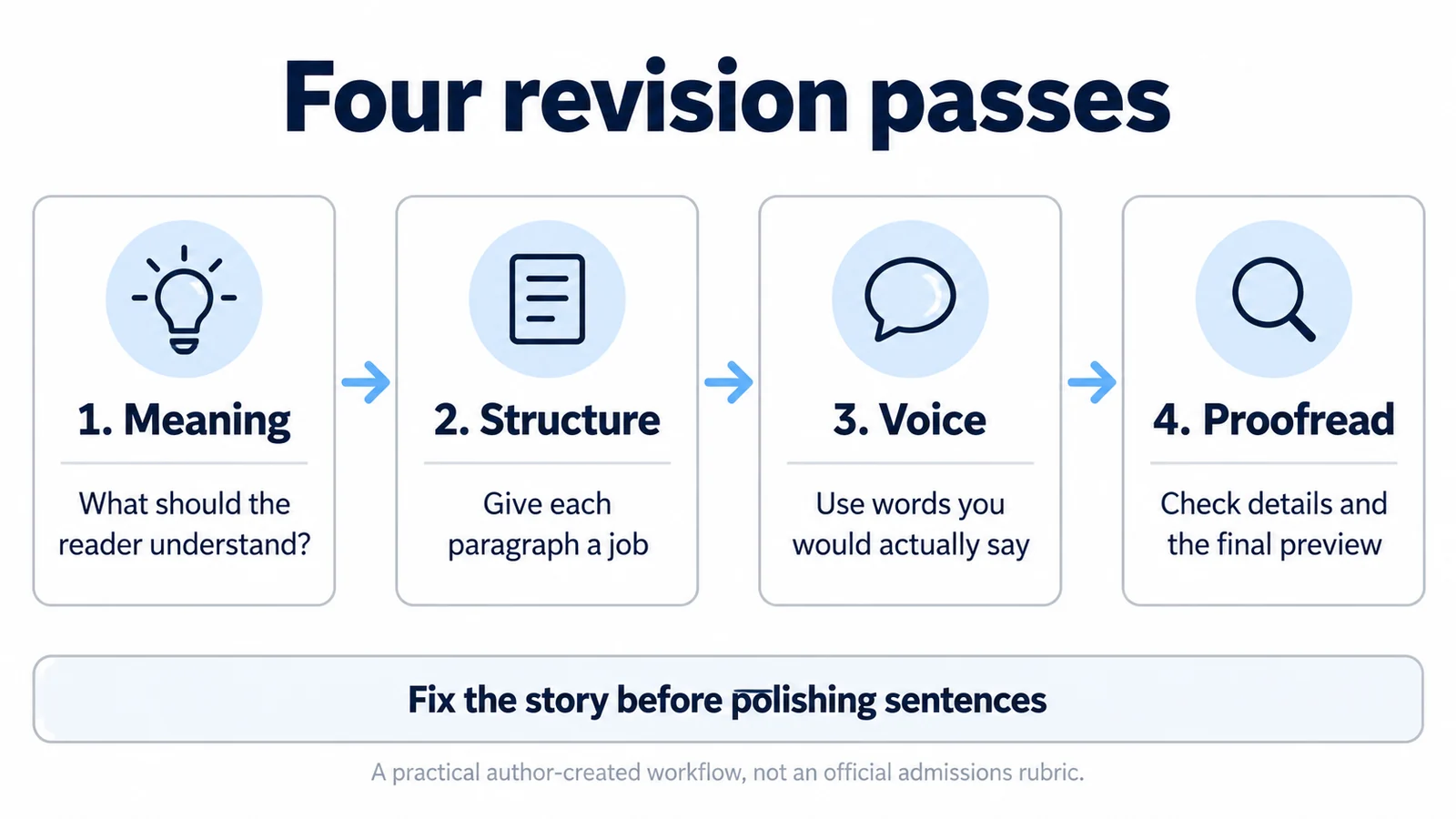
Do not spend your first session perfecting a sentence that might disappear when you reorganize the story. Start with the biggest uncertainty. If a reader cannot tell why the event matters, adding more elegant transitions will not solve that problem.
First, Make The Meaning Specific
Read the draft without correcting grammar. Underline what happened, then circle places where you explain what you noticed, chose, questioned, or changed. If nearly everything is underlined, you may have a recap rather than a personal essay.
Consider this invented example:
Our fundraiser was successful, and I learned the importance of teamwork.
That sentence reports an outcome and names a broad lesson. A more revealing version might be:
I had assigned every task myself. When Maya asked why nobody had chosen their own role, I realized I had confused organizing the group with listening to it.
The second version is useful because it identifies a decision and a shift in thinking. It is not a sentence to copy. Look for the equivalent moment in your own experience, using only details you remember honestly.
Reflection does not require a dramatic transformation. You can describe a habit you are still changing or a question you have not settled. Do not invent a tidy lesson because you think every essay needs one.
Next, Give Each Paragraph A Job
Write a short label beside every paragraph: setting, problem, choice, consequence, or reflection. The labels can differ, but you should be able to explain why each paragraph belongs.
If three paragraphs all provide background, try keeping the one detail readers need and moving sooner to your decision. If an important change seems sudden, add the missing connection rather than another description of the setting.
Use these checks:
- Can a reader follow the sequence without knowing you?
- Does the essay show your role rather than mostly describing another person?
- Are you repeating an accomplishment already clear elsewhere in the application?
- Does the ending add insight rather than repeat the opening?
Keep useful context. Cutting every explanatory sentence can leave a reader lost. The goal is enough information to understand the moment, with room left for your perspective.
Then, Read Your Language Aloud
Read the draft slowly, as if explaining the experience to a teacher who knows you. Mark words you stumble over and sentences you would feel odd saying. A formal sentence is not automatically wrong, but it should still feel like yours.

Compare "I endeavored to facilitate productive collaboration" with "I asked everyone what they wanted to try." Choose the version that accurately describes what you did. Simpler wording often leaves more room for the detail that matters.
Preserving voice does not mean keeping confusing grammar or every casual phrase. You can fix an unclear reference, divide a long sentence, or remove filler without changing your meaning. Likewise, do not force slang or jokes into an essay to make it sound youthful.
When a sentence feels wrong, look away from the screen and explain the idea aloud. Then write your explanation in your own words. This is often more useful than swapping individual words for supposedly stronger synonyms.
Ask Readers For Observations, Not Rewrites
Choose one or two trusted readers with different strengths, such as someone who knows you well and someone who can spot unclear writing. Give them specific questions:
- What did you learn about me?
- Where did you need more context?
- Which sentence sounded least like me?
- What felt repetitive?
Sort their comments into three groups: fix, consider, and decline. A factual error belongs in fix. A confusing transition deserves consideration. A request to replace your honest reaction with a more impressive one may deserve a polite decline.
If two readers disagree, return to your purpose sentence and the prompt. Ask what problem each suggestion is trying to solve. You might accept the observation that a paragraph is unclear while rejecting the replacement paragraph someone wrote for you.
Essay Studio can support feedback and revision planning. Use it to identify questions to investigate, not to write replacement passages or invent experiences. Keep the wording and final decisions yours, and check the rules that apply to your applications.
Proofread The Version You Will Submit
Once the story works, make a separate proofreading pass. Check names, chronology, punctuation, repeated words, and any claims about your role. Cut repetition before cutting the specific detail that makes the story personal.
Confirm the exact word limit and requirements in the application you are completing. Common App's first-year application guide explains that colleges can require or make optional the personal essay, and some have additional questions or separate writing supplements. Do not assume one finished essay completes every writing requirement.
After pasting your draft, read the application preview. Check paragraph breaks, missing text, and accidental duplication. Save the final version with a clear filename so you do not submit an older draft by mistake.
Know When To Stop Revising
Your essay is ready for a final check when it answers the prompt, follows a clear thread, includes honest specifics, and sounds like you. It does not need unanimous approval from everyone who reads it.
For your next session, choose one pass and one concrete goal: clarify the turning point, shorten the background, or replace a sentence you would never say. Finish that task before collecting more feedback. Good revision helps the reader hear you more clearly; it does not give you a different voice.