How to Stay Organized During College Application Season
A practical system for tracking college deadlines, essays, recommendations, and next steps without losing momentum.
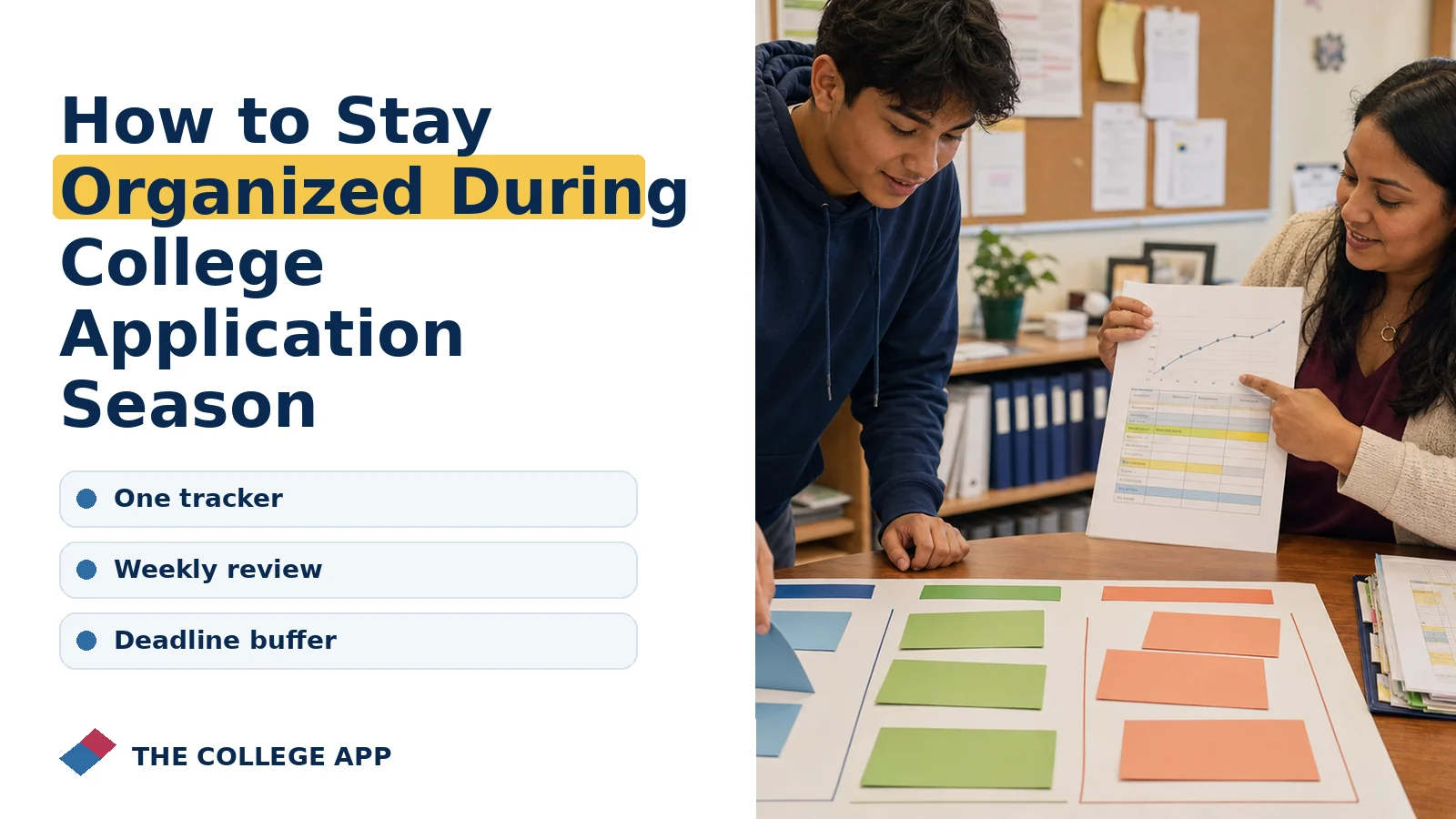
If your application plan lives in five browser tabs, three text messages, and a vague promise to "work on it this weekend," it is too easy for something important to slip. College application season has a lot of moving parts, but the work becomes more manageable when every task has a place to live. The Common App first-year guide is a useful starting checklist, but each college's own requirements still control.
You do not need a perfect color-coded system. You need one system you will actually check.
Start With One Master List
Before you make a calendar, build one master list of every college you are seriously considering. This is your control center. It should be simple enough that you can update it in a few minutes.
For each college, track:
- Application deadline
- Application platform, such as Common App, Coalition, or the college's own portal
- Decision plan, such as early action, early decision, regular decision, or rolling admission
- Required essays or short-answer questions
- Recommendation requirements
- Transcript or school report requirements
- Test score policy, if relevant to your plan
- Portfolio, audition, interview, or major-specific materials
- Financial aid and scholarship deadlines
- Portal login status after you apply
Use a spreadsheet, notebook, notes app, or deadline tool. The format matters less than the habit of keeping it current. If you are using The College App, the Deadline Tracker can help you keep dates and tasks in one place instead of rebuilding the same checklist every week.
Sort Tasks By Type, Not By Panic Level
When everything feels urgent, students often jump to whatever is loudest. That might be the essay tab that is already open, a reminder from a parent, or a school with a deadline that sounds close. A better approach is to group tasks by type so you can work in batches.
Try these categories:
- Research: confirming requirements, checking majors, reviewing costs, and reading admissions pages
- Writing: personal statement, supplemental essays, activity descriptions, and scholarship responses
- People: recommendation requests, counselor forms, transcript requests, and parent financial aid information
- Forms: application questions, residency details, family information, honors, and activities
- Review: proofreading, checking portals, confirming submissions, and saving receipts
Batching helps because each type of task uses a different kind of focus. Writing needs quiet time. Form work needs accurate details. Recommendation requests need clear communication. Research needs patience and official sources.
If you try to do all of those at once, even a short work session can feel scattered.
Build A Weekly Application Routine
College applications are easier to manage when they become a weekly routine instead of a series of emergency sessions.
Pick two or three application blocks per week. They do not need to be long. A 45-minute block after school can be enough if you know what you are doing before you sit down.
Use this rhythm:
- Review the next two weeks of deadlines.
- Pick one main task for the session.
- Gather what you need before starting.
- Work without switching colleges every few minutes.
- End by writing the next action in your tracker.
That last step matters. "Work on State University app" is too vague. "Revise the 250-word community essay" is clear. "Ask Ms. Rivera for recommendation by Friday" is clear. Specific next actions reduce the amount of thinking you have to do when you come back later.
Use A Deadline Ladder
Do not plan around the final deadline only. Build a deadline ladder for each application so you finish the parts in the right order.
Here is a simple ladder:
- Four to six weeks before: confirm requirements and decide whether the college stays on your list
- Three to four weeks before: ask for recommendations and request transcripts if needed
- Two to three weeks before: draft essays and complete most form sections
- One week before: proofread, review requirements, and check payment or fee waiver details
- Two to three days before: submit if everything is ready
- After submission: create or check the applicant portal and save confirmation emails
Submitting a few days early is not about being perfect. It gives you room for login issues, missing documents, payment problems, or last-minute questions. If a college has a separate scholarship or honors deadline, put that on the ladder too.
Keep Essay Work Organized
Essays can create the most clutter because one college might have three prompts, another might reuse a theme, and a third might ask for a tiny answer that still takes time.
Make an essay tracker with these columns:
- College
- Prompt
- Word or character limit
- Draft status
- Last edited date
- What the essay is really asking
- Next revision task
The "what the essay is really asking" column keeps you from recycling the same answer blindly. A "why this major" essay, a "why this college" essay, and a "community" essay may all mention similar experiences, but they should not sound interchangeable.
Give each essay a clear file name. Include the college name, prompt topic, and draft stage. For example: Northside_WhyMajor_Draft2. Avoid file names like essay final final REAL final because they become useless when you are tired.
Ask Other People Early
Some application tasks depend on other people. Those need extra time.
Ask recommenders at least a few weeks before the deadline when possible. Give them the deadline, the college list, any required submission details, and a short reminder of what you hope they can highlight. A brag sheet or short activity summary can help them write with more detail.
For counselors, ask how your school handles transcripts, school reports, and recommendation forms. Some schools have their own internal deadlines before the college's official deadline. Missing an internal deadline can slow down your whole plan.
For family information, check what you will need for application forms and financial aid forms. You may need household details, residency information, or help checking cost and aid deadlines. Do not wait until the night before a deadline to ask a parent or guardian for information they may need time to find.
Use A Submission Checklist
Before you submit any application, slow down and run the same checklist every time.
- The college name and deadline match the application plan.
- Your decision plan is correct.
- All required questions are answered.
- Essays are attached or pasted into the right fields.
- Essay formatting still looks clean after pasting.
- Activities and honors are in the order you want.
- Recommenders and counselor forms are assigned correctly.
- Transcript requirements are handled through your school process.
- Test score choices match your plan and the college's policy.
- Fee waiver or payment information is ready.
- You saved or downloaded a copy of your application if the platform allows it.
After submitting, add the portal step to your tracker. Many colleges send applicant portal instructions after submission. That portal is where you may need to confirm materials, check missing items, upload updates, or view decisions later.
Protect Your Energy
Organization is not only about dates and files. It is also about keeping yourself from burning out.
A good system should help you answer three questions quickly:
- What is due next?
- What is blocked because I need someone else?
- What can I finish in the next work session?
If your tracker cannot answer those questions, simplify it. Remove columns you never use. Combine duplicate notes. Highlight only the next important deadline instead of making every cell urgent.
Also build in stopping points. When you finish a task, mark it done and step away. Application season can make students feel like there is always one more thing to improve, but endless tweaking is not the same as progress.
Make The System Easy To Restart
You will have busy weeks. You may miss a planned work session. You may open your tracker after a few days and feel behind. That does not mean the system failed.
When you need to restart, do this:
- Check the next deadline.
- List anything waiting on another person.
- Pick one task you can finish today.
- Update the tracker after you finish it.
College application season rewards steady follow-through more than dramatic planning. Put every deadline, essay, request, and next step in one place. Then keep returning to that place until the work is done.