Questions to Ask Your School Counselor About College Applications
Prepare for a useful counselor meeting with questions about requirements, deadlines, recommendations, transcripts, and your next steps.
If your counselor meeting is only 15 minutes, a short list of specific questions can help you leave with a plan instead of more tabs open. Bring your current college list, a rough deadline view, and the parts of the application that feel unclear.
The Common App first-year application guide explains that each college sets its own requirements for deadlines, fees, essays, testing, portfolios, and recommendations. That makes your counselor a useful partner for finding what needs school action, what you must submit yourself, and what still needs to be confirmed on each college's official page.
Start with the questions that affect your college list
Your counselor can help you test whether your list reflects your goals, preparation, budget, and available support. Ask:
- Does my list include different kinds of options, and what should I verify about each one?
- Are there colleges on my list where my current courses or preparation deserve a closer look?
- What information should I collect before deciding whether a college belongs on my list?
- Which campus, major, or program questions should I take directly to the college?
Ask for reasoning, not a verdict. A counselor may point you toward course planning, a college's published requirements, a financial aid office, or a campus program. You still need to compare the details yourself because colleges make their own decisions about requirements and deadlines.
For each college, keep a small verification list: application platform, deadline type and date, essays or supplements, testing policy, recommendation requirements, transcript requirements, and financial aid steps. The college's official admissions page and application account should be your final check when information changes.
Ask what your school must send
Students often focus on the application they complete and forget the forms their school submits. Common App says counselors submit the School Report and transcripts in its first-year process, while teachers and other recommenders may submit separate forms. Ask:
- Which transcript will my school send, and when can it be requested?
- Does my school require a transcript request form, processing time, or fee?
- What school forms, profile information, or counselor reports will colleges receive?
- How should I tell you which application platform I am using for each college?
- How will I know that a transcript or school form has been sent?
These questions are especially helpful if your list includes colleges using different application systems or if your school has an internal process. Write down the person or office responsible for each step and the date by which you should follow up.
Clarify recommendation letters early
Recommendation requirements vary by college. Common App's recommendation process guide recommends asking a recommender before sending an invitation and giving them meaningful advance notice. Use your meeting to ask:
- Which colleges on my list require a counselor recommendation, teacher recommendations, or both?
- What is the earliest date I should ask, and what information would help you write a useful letter?
- Would a résumé, activity list, or brag sheet give you helpful context?
- How should I share my deadlines, and how can I check the submission status?
- What is the best way to thank or update my recommenders?
Do not wait until the application deadline is close to discover that a recommendation has its own school deadline. Give recommenders a clean list of colleges, submission dates, and any instructions they need. If a college has a special recommendation rule, confirm it in the college's own requirements page.
Ask about deadlines and a realistic calendar
A counselor can help you turn a collection of dates into a sequence of tasks. Ask:
- Which deadlines apply to me: early action, early decision, regular decision, rolling, or scholarship deadlines?
- Which steps need to happen before I can submit an application?
- What should I finish first if two deadlines are close together?
- Are there school deadlines earlier than the college's published deadline?
- When should I check that recommendations, transcripts, and test scores were received?
Make your own calendar during or immediately after the meeting. Record the official deadline, your earlier personal target, required materials, and the next person you need to contact. Add a reminder to verify the application portal after submission; sending your portion does not mean every supporting document has arrived.
Talk about testing, fees, and financial aid questions
Testing and application costs are easy to treat as afterthoughts. Instead, ask your counselor:
- Where can I find each college's current testing policy, and should I send scores?
- Do I qualify for application fee waivers, and how does my school confirm eligibility?
- Which financial aid forms and deadlines should my family track?
- Are there local scholarships or school-based resources with separate deadlines?
- Who should answer questions about a college's aid offer or billing?
Your counselor can help you identify the right office and documents, but do not rely on a general conversation for a final policy. Check Federal Student Aid, the college's financial aid office, and the current instructions in each application when a question involves money or eligibility.
Prepare a meeting that fits your counselor's time
NACAC describes school counselors as an important part of postsecondary planning, but your counselor may be supporting many students. A focused meeting is more useful for everyone.
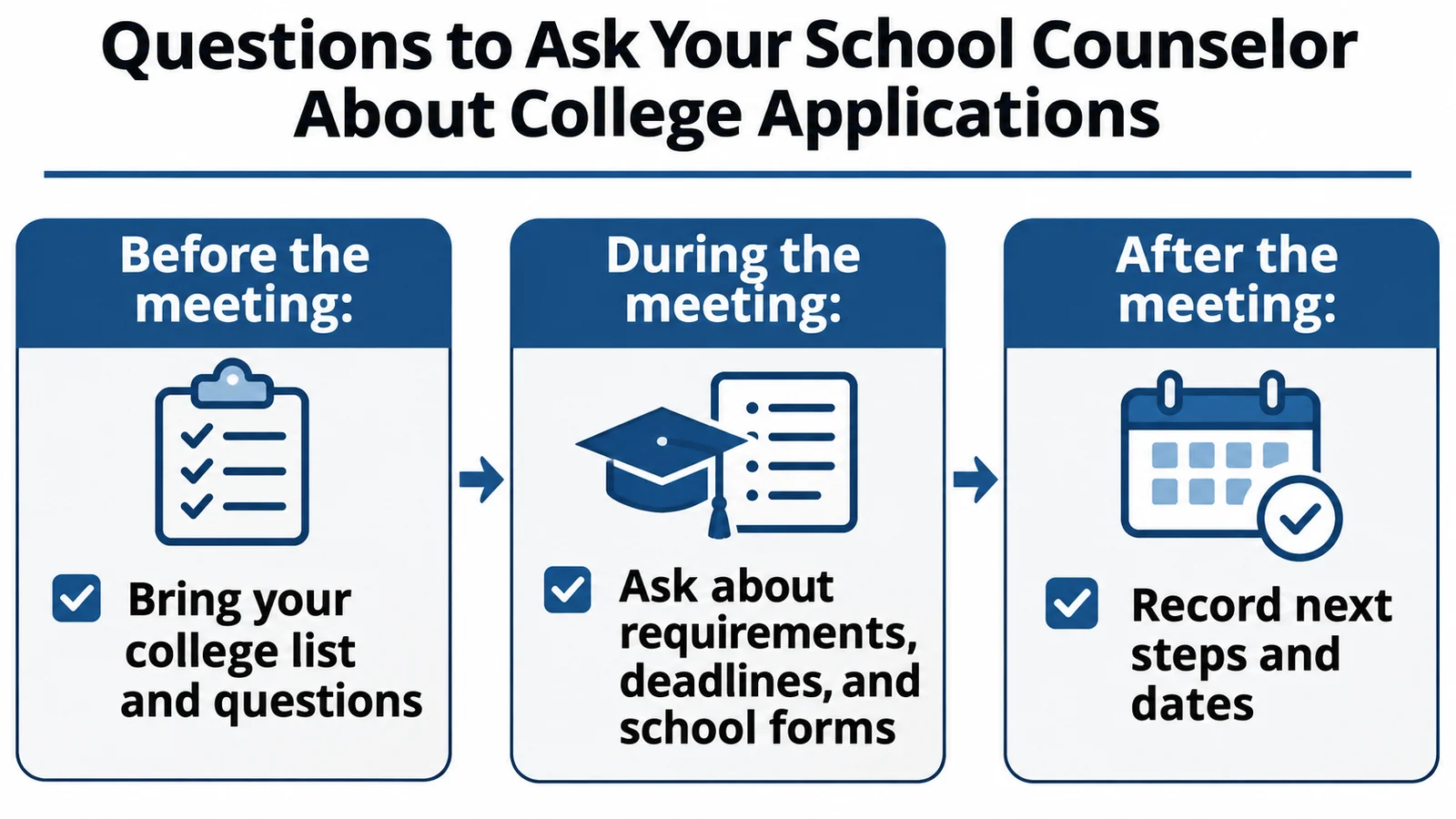
Before you meet:
- Put your colleges and likely deadlines in one document.
- Mark each question as must answer, helpful, or can research later.
- Bring a list of current courses, activities, jobs, family responsibilities, and accomplishments.
- Note anything that changed since your last conversation.
- Ask whether you should schedule a follow-up before a specific deadline.
During the meeting, take notes in the same order as your application calendar. If your counselor cannot answer a policy question, record the official office or page you should use instead.
Tools like ColleGPT can help you turn a broad concern into a short meeting agenda or organize follow-up questions. Use it for planning and clarification, then verify application requirements with your counselor and each college's official instructions.

Leave with three written next steps
Before you leave, summarize:
- What I will do next: for example, request a transcript or confirm a recommendation.
- What my counselor or school will do: for example, submit a school report or explain the transcript process.
- What I will verify with the college: for example, a testing policy, supplement, or deadline.
Add a date to each item. Then send a brief thank-you message that repeats the deadlines or questions that still need follow-up. If you keep the plan updated, your next counselor meeting can focus on decisions instead of reconstructing what happened last time.
The goal is not to ask every possible question in one conversation. It is to identify the next few actions that keep your application accurate, complete, and on schedule. Start with your college list, ask about the school-sent materials, confirm recommendation timing, and leave with dates you can act on.