College Terms Every First-Generation Student Should Know
Learn the college application, financial aid, and campus support terms that make the process easier to understand.

If you are the first person in your family to attend college, the hardest part of an application may be the vocabulary around it. A counselor might mention a school report, a college may refer to net price, and a financial aid form may ask about a contributor. These words are manageable once you know what they mean and what action each one points to.
Use this glossary as a working reference. When a college uses a term differently or adds a requirement, follow that college's official page and ask its admissions or financial aid office for clarification.
Application Terms to Know Before You Submit
Common App's first-year guide breaks the process into practical steps: gather materials, create an account, add colleges, engage supporters, understand requirements, plan essays, and submit. The terms below fit inside that workflow. Read Common App's first-year application guide for the official sequence and college-specific requirements.
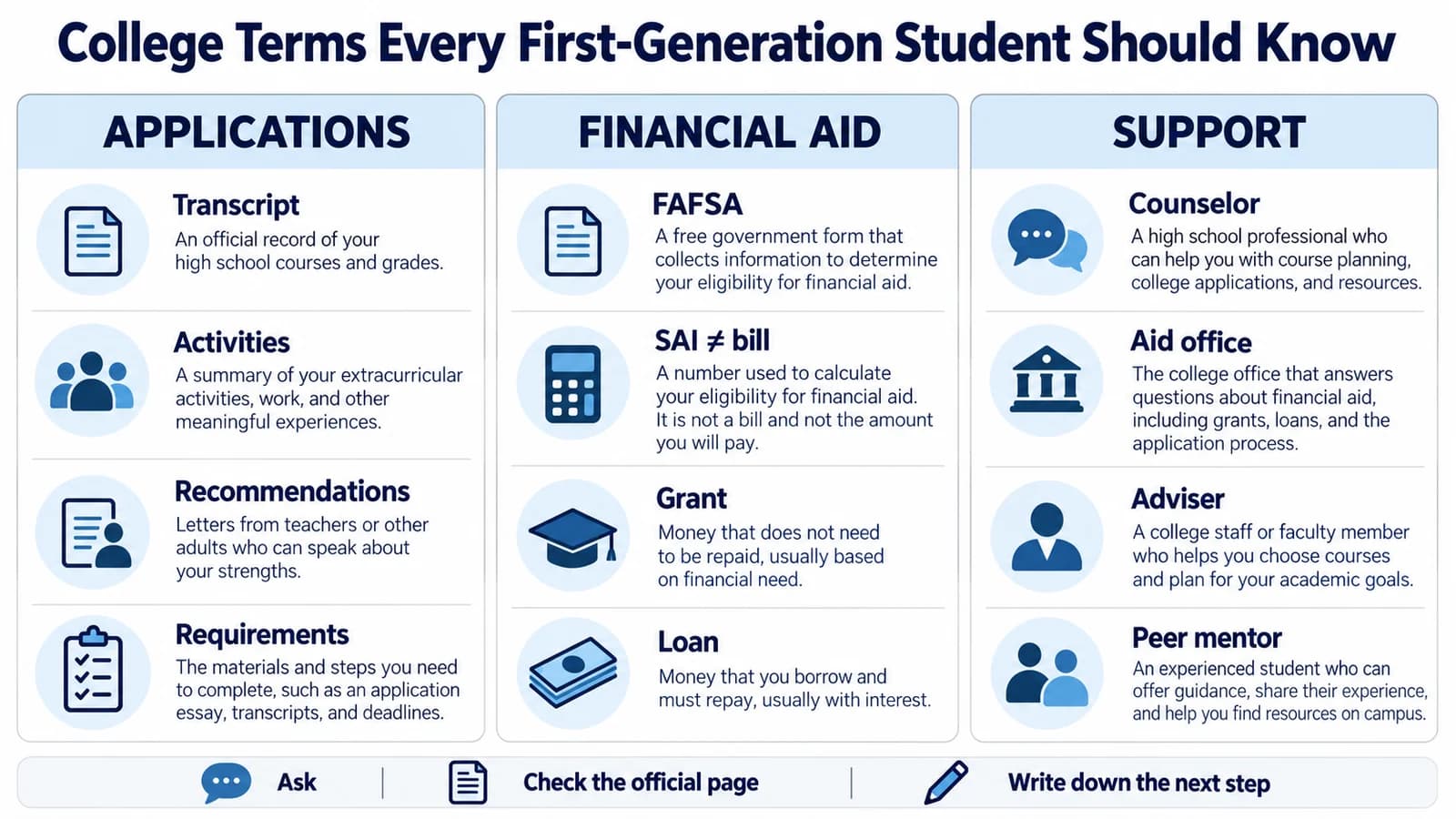
Transcript
Your transcript is the official record of your high school courses and grades. Colleges use it to understand what you studied and how your academic record developed. Ask your counselor how your school sends transcripts and whether a college needs an official copy after you enroll.
Activities
The activities section is where you describe meaningful commitments outside regular classes. These can include a job, family responsibilities, a club, community involvement, athletics, or a hobby. You do not need an impressive-sounding title for an activity to matter. Describe what you actually did, how long you did it, and what responsibility you held.
Recommendation
A recommendation is a letter or evaluation from someone who can describe your strengths and how you contribute. Colleges choose their own recommendation requirements. A teacher may speak about your work in class, while a counselor provides context about your school and academic path. Ask early, share your deadlines, and give the recommender useful information about your goals and work together.
School report and counselor forms
Some colleges ask a counselor to send a school report, transcript, or other school forms. These are not the same as the parts you complete yourself. Add each form to your tracker, identify who submits it, and check the applicant portal after the deadline to confirm the college received it.
Requirements
Requirements are the materials and steps a particular college expects before it can review your application. One college may require a recommendation or essay that another does not. Common App says to check each college's information page for testing, writing, deadlines, and other requirements. Do not rely on a general list you found elsewhere when the college's own page is available.
Fee waiver
A fee waiver removes an application fee when you meet the relevant eligibility rules. Common App explains that its fee waiver must be confirmed by a counselor, while some colleges offer their own waiver. Ask your counselor which process applies before you submit.
Financial Aid Terms That Prevent Confusion
Financial aid vocabulary matters because several words can sound interchangeable even when they describe different things. Federal Student Aid's financial aid dictionary is the best place to verify definitions and current federal guidance.
FAFSA and contributor
The FAFSA is the Free Application for Federal Student Aid. Colleges and career schools use information from it to determine eligibility for federal, state, and school aid. A contributor is a person required to provide information and consent on the form; the form will tell you who needs to participate. Being a contributor does not mean that person is automatically responsible for paying your college bill.
FAFSA Submission Summary
After your FAFSA is processed, the FAFSA Submission Summary shows the information you reported and may include an estimated aid overview, your Student Aid Index, and a verification indicator. It is not a financial aid offer. A school sends its own aid offer after admission and after reviewing the information it needs.
Student Aid Index, or SAI
The Student Aid Index is an index calculated from FAFSA information that a school uses when determining financial need. It is not a bill and it is not the amount your family will pay. Treat it as one input in the aid process, then wait for each college's offer and compare the actual costs and aid listed there.
Cost of attendance and net price
Cost of attendance is the college's estimate for the full cost of attending, including items such as tuition, fees, books, food, and housing. Net price is an estimate of what you may need to pay after grants and scholarships are subtracted. Neither term should replace the college's own aid offer when you are comparing options. Ask what is included and whether the estimate matches your living situation.
Grant, scholarship, loan, and work-study
- Grant: Aid that generally does not need to be repaid, often based on financial need.
- Scholarship: Aid awarded by a college, organization, foundation, or other provider under its own rules. Check whether it can be renewed.
- Loan: Money you borrow and repay, usually with interest. Read the terms before accepting it.
- Federal Work-Study: A program that can provide a part-time job for an eligible student. It is an opportunity to earn wages, not money deposited automatically at the start of the term.
Federal Student Aid explains these distinctions and recommends asking the financial aid office how an offer works at that specific school. A tool like ColleGPT can help you turn unfamiliar terms into a list of questions, but verify financial aid details with the college and StudentAid.gov.
Campus Terms That Help You Find Support
Knowing who to contact can be as useful as knowing a definition. Save these offices and people in your notes while you research colleges:

- Admissions office: Answers questions about applying, requirements, deadlines, and application status.
- Financial aid office: Explains FAFSA follow-up, aid offers, scholarships, work-study, and billing questions related to aid.
- Academic adviser: Helps you choose courses and make an academic plan. At some colleges, the role may be called an adviser, counselor, or success coach.
- First-generation program: A campus program or community designed to support students who are first in their families to attend college. Ask what services it actually provides.
- Peer mentor: A trained or experienced student who can share how they found campus resources. A peer mentor cannot replace official advice, but they can help you identify where to ask.
- Office hours: Times when a professor or staff member is available for questions. Check the course or office page for the schedule and format.
The names vary by campus. If you cannot find the right office, start with admissions and ask, “Who handles this question for first-year students?” That one question can get you to the right person faster than searching every page alone.
A Simple Way to Use New Terms
When you hear a term you do not recognize, use this four-step process:
- Write the exact phrase. Copy it from the email, portal, form, or college page.
- Find the official definition. Start with the college, Common App, or StudentAid.gov rather than a random glossary.
- Connect it to an action. Decide whether you need to submit something, ask someone, compare a cost, or save a deadline.
- Record the answer. Keep the definition, source link, person contacted, and next step in one application note.
For example, if your portal says “verification,” do not guess that it means your application was rejected. Look up the college's instructions, check what documents it requests, and contact financial aid if the next step is unclear.
Questions to Ask Without Apologizing
You are allowed to ask for plain language. Try these questions:
- Which parts of my application does my school send, and which parts do I send?
- Is this a required item for every applicant or only for this program?
- Is this amount a grant, a loan, work-study, or an estimate?
- Is the SAI an amount I owe?
- What is the difference between this college's cost of attendance and my likely net price?
- Which office should I contact if I need help after I enroll?
Write down the answer and the name of the person who gave it. Clear questions are a strength because they help you make decisions with better information.
Keep Building Your Own College Dictionary
You do not need to memorize every term before you apply. Start with the words attached to your next deadline, verify definitions through official sources, and keep a running list you can reuse. Once you know who handles applications, financial aid, and campus support, unfamiliar language becomes a prompt to ask the next useful question—not a reason to stop.