How to Write a Why This College Essay
Build a specific, personal Why This College essay by connecting your goals and experiences to details you genuinely value at the school.

If a college asks why you want to attend, do not answer with a brochure summary. Answer with the connection between something you care about and the specific opportunities you found at that school.
A strong Why This College essay gives the reader two things at once: a clearer sense of you and a credible reason this college belongs on your list. The goal is not to prove that you researched the school. The goal is to show what you would explore, contribute to, or continue there—and why.
Understand what the prompt is really asking
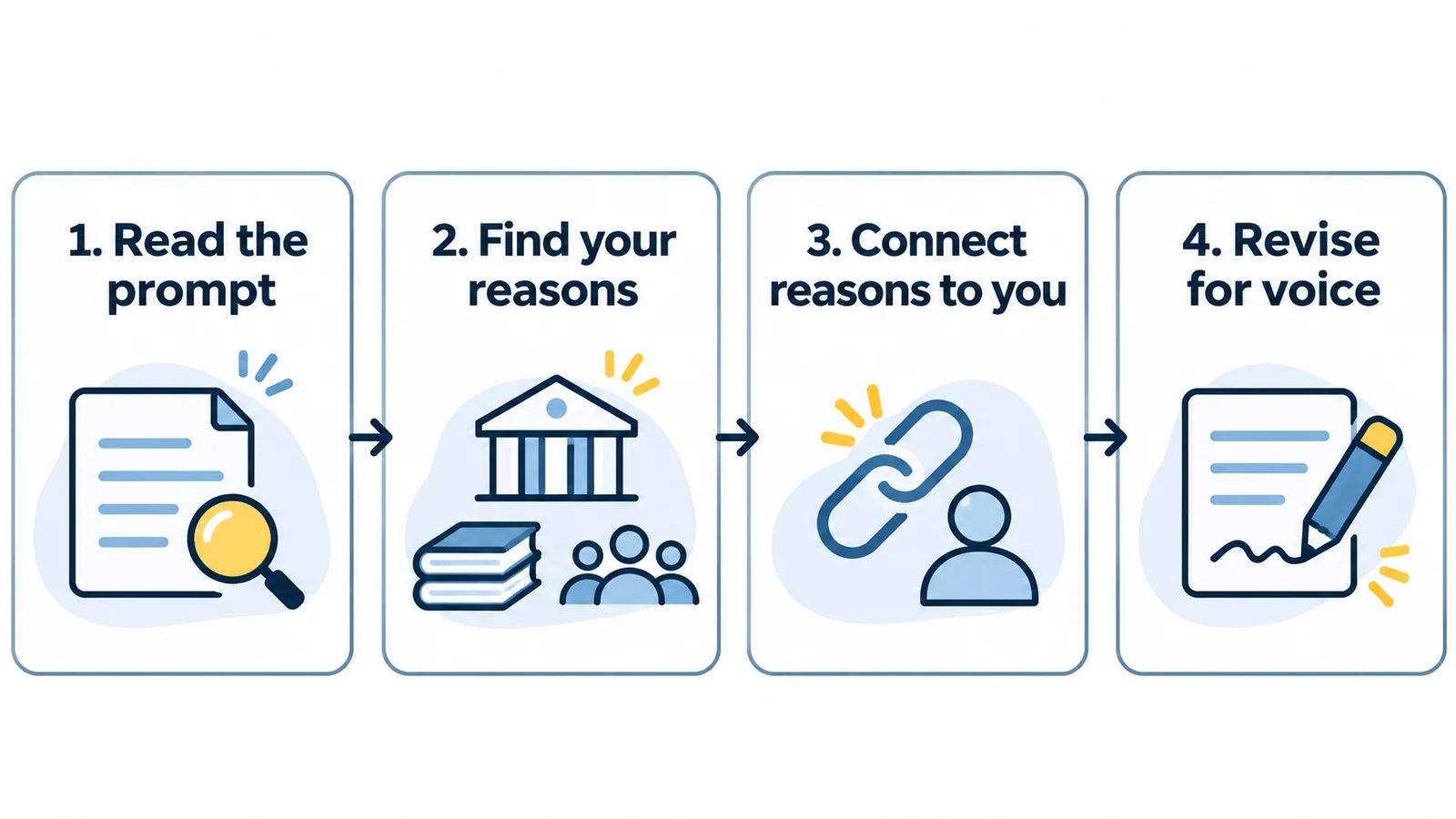
Start by reading the exact prompt and its word limit. Colleges use different wording, and some no longer ask a traditional “Why us?” question. A prompt may ask about an academic interest, a community, a program, or what you hope to discover on campus.
Underline the task words. Is the college asking what attracts you, how your interests developed, what you would contribute, or how a specific program fits your plans? Your draft should answer that question directly instead of forcing every school into the same template.
Official admissions guidance is a useful reality check. Yale’s essay advice tells applicants to write about something meaningful, share a unique perspective, and use their own voice. Princeton’s helpful tips similarly emphasize writing in your own voice and making sure the essays are your own work. Those principles apply even when a prompt is short.
Find reasons that are specific to you
Before researching the college, write down what you want from your next learning environment. You might care about:
- A way to combine two subjects, such as environmental science and public policy
- A teaching format that helps you learn, such as studio work, seminars, or undergraduate research
- A community connected to an experience you have had or a question you keep returning to
- A location that supports a goal, such as fieldwork, public service, or access to a professional community
- A campus activity where you could contribute a skill, perspective, or sustained interest
Do not worry about making this list sound polished. The point is to identify real starting points. “I want a good education” is too broad to guide an essay. “I want to keep studying how water quality affects neighborhoods after volunteering with a local watershed group” gives you something to investigate.
Next, look for college details that genuinely connect to those starting points. Use the school’s official academic department pages, course catalog, student-organization pages, research descriptions, and admissions materials. Record the page title and URL as you research so you can confirm details before submitting.
Build the you-to-college connection
Specificity matters, but a list of impressive-sounding resources is not a connection. For every college detail you include, explain why it matters to you.
Use this simple chain:
- Your starting point: What experience, question, value, or goal brought you here?
- The college detail: What exact course, approach, program, community, or opportunity supports it?
- Your next step: What would you hope to learn, make, investigate, or contribute?
For example, a student who repaired old laptops for a neighborhood nonprofit might write about wanting to study the social effects of technology access. They could connect that interest to a specific interdisciplinary course, a community partnership, and a plan to bring their repair experience into campus service work. The details matter because they reveal how the student thinks—not because the names sound prestigious.
Research without turning the essay into a catalog
Choose two or three details you can discuss with substance. Strong details tend to be concrete and connected to an interest you already have. They might include a course sequence, a research question, a student-led project, a major requirement, or a community tradition that fits your experience.
Be careful with facts that change. Course titles, faculty roles, program names, and student opportunities can be updated. Confirm each one on an official college page shortly before you submit. If you cannot verify a detail, leave it out or describe the broader opportunity accurately.
Avoid dropping in a professor’s name, a campus landmark, or a slogan just to sound informed. A fact has value only when you can explain what it means for your own goals. Yale admissions officers have written that applicants should focus on their own reflection rather than simply listing facts about Yale; that is a useful warning for any college-specific response. Read the school’s current prompt and guidance instead of assuming every college wants the same essay.
Draft a structure that stays focused
A short Why This College essay can follow this structure:
- Opening: Begin with the interest, experience, or question that makes the college relevant to you.
- Connection one: Explain one specific academic or learning opportunity and why it fits your direction.
- Connection two: Add a community, project, or environment detail that extends the same idea.
- Closing: Show the next step you hope to take, without making a promise about admission or your entire future.
The structure is flexible. You do not need to announce, “This is why I want to attend.” Let the details and your reasoning make that clear. Two well-explained connections are usually more convincing than six names with no reflection.
Revise for your voice and accuracy
Set the draft aside, then read it as if you were checking whether a new person could understand your interest. Highlight every sentence about the college. For each one, ask: “What does this reveal about me?” If the answer is “nothing,” replace a fact with reflection or remove it.
Use this final checklist:
- I answered the exact prompt, not a generic version of it.
- I named only details I verified on official college pages.
- I explained why each important detail connects to my goals or experience.
- The essay could not be sent unchanged to another college.
- My examples sound like something I would actually say.
- I stayed within the word limit and removed repeated praise.
- A trusted reader checked clarity and grammar without rewriting the essay for me.
Read the essay aloud once. Awkward phrases, inflated claims, and sentences that sound unlike you are easier to notice by ear. Feedback can help you spot gaps, but you should keep control of the final wording. The essay should remain your work and your voice.

Make your next move
Start with a rough list of your interests, then research one college with that list in hand. You will write a more convincing essay when you begin with a real question or goal instead of a collection of school facts. Tools like Essay Studio can help you organize ideas, compare a draft with the prompt, and plan revisions while you remain the author.
Before submitting, return to the official college page for the prompt and any current instructions. A focused essay does not need to praise everything about a school. It needs to make one honest, specific connection—and show why that connection matters to you.