An Eight-Week Digital SAT Study Plan
Build an eight-week Digital SAT routine with a baseline, targeted practice, timed tests, and a realistic test-day plan.

If your Digital SAT date is about eight weeks away, do not fill every day with random questions. Start with one official baseline, use the results to choose what to practice, and reserve time to review the mistakes that keep repeating.
This plan is a flexible eight-week framework, not a promise of a particular score. Adjust the workload for your school schedule, activities, accommodations, and test date. The goal is to make each week answer one useful question: what should I do next?
Before Week 1: Set Up Your Practice System
Use the official College Board Digital SAT practice tests in Bluebook. A full-length practice test introduces the digital format and gives you results to review in My Practice. Choose a quiet block of time and treat it like a real test, including the breaks you expect to use.
Create one simple review log with four columns:
- Question or skill
- Why I missed it
- What I will try next time
- Date to revisit it
The reason matters more than a tally. A missed question might reflect a content gap, a misread detail, a rushed decision, or an avoidable calculator or timing mistake. Those require different next steps.
The Eight-Week Rhythm
The phases below keep the plan focused without pretending that every student needs the same number of hours.
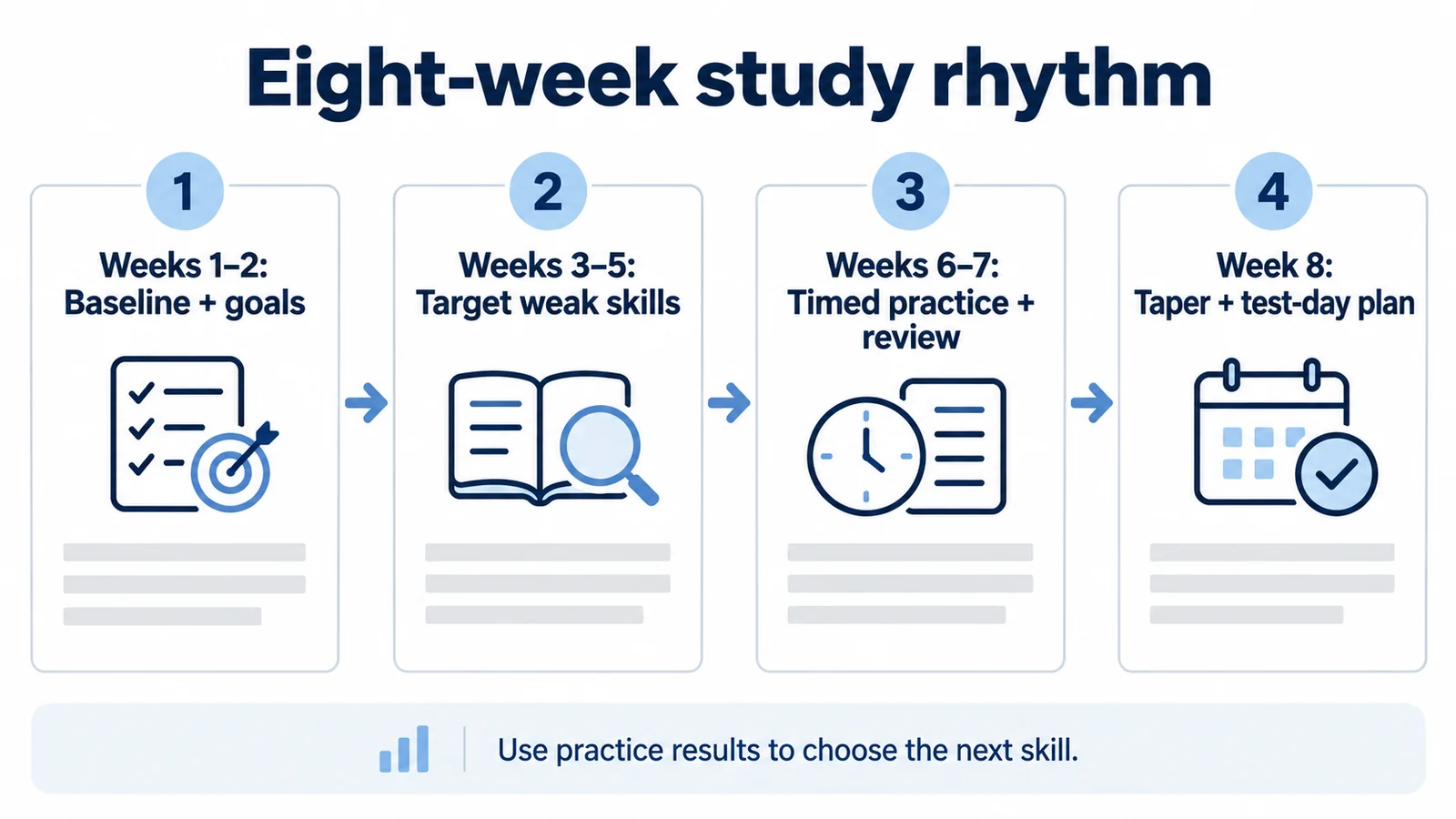
Weeks 1–2: Take a Baseline and Choose Goals
Start with one full-length Bluebook practice test if you can. Do not use the score as a verdict about your ability. Use it as a map of what to investigate.
Afterward, review the score report and the individual questions. Mark patterns in both Reading and Writing and Math. For example, you might notice that you understand the underlying math but lose time on multi-step questions, or that you can explain a grammar rule but miss it when the sentence is dense.
Choose two or three priorities for the next few weeks. A useful priority is specific enough to practice: “linear equations with a graph” is more actionable than “get better at math.” Set a process goal too, such as completing three focused sessions per week and reviewing every missed question.
Keep the first week manageable. A plan that fits around school is more useful than an ambitious schedule you abandon after four days.
Weeks 3–5: Practice the Skills Behind Your Mistakes
Now turn your review log into short, targeted sessions. College Board’s Student Question Bank lets you filter official questions by section, domain, skill, and difficulty. Use those filters to practice one priority at a time instead of mixing everything together immediately.
A 30- to 45-minute session can follow this pattern:
- Review one example or rule you need.
- Complete a small set of questions without looking at explanations first.
- Check each answer, including the ones you guessed correctly.
- Write the reason for every miss or slow solution.
- Choose one question or concept to revisit later in the week.
Do not turn review into passive answer reading. Explain why the correct answer works and why your choice did not. For Reading and Writing, pay attention to the evidence in the passage and the exact job of the question. For Math, write down the relationship or representation you overlooked before trying another similar problem.
If you use Official SAT Prep on Khan Academy, use it for lessons and practice connected to the skills you identified. The resource should support your review log, not create a second unorganized list of assignments.
Tools like Test Prep in The College App can also help you keep a study routine and mistake review in one place. Use it as a planning aid while treating College Board materials as the source for official practice content.
Weeks 6–7: Add Timed Practice and Review the Whole Test
Take another full-length practice test during this phase, ideally with enough time afterward to review it carefully. College Board notes that full-length Bluebook practice tests are timed like the real test and that results are available in My Practice when you are signed in.
Compare the new review log with the first one. Look for three kinds of change:
- More consistent skills: Move these to maintenance practice.
- Persistent errors: Return to the underlying concept or question type.
- Timing patterns: Practice a decision rule, such as flagging a time-consuming question and returning to it rather than guessing under pressure.
Your practice test is most valuable after the test. Block a separate review session instead of squeezing the analysis into the last few minutes. If a score changes, avoid overinterpreting one result. Look for repeated patterns across questions and sessions.
Week 8: Taper and Make Test Day Boring
The final week is for confidence through familiarity, not for cramming every topic. Complete shorter sessions using your review log. Revisit common mistakes, practice the tools you will use, and stop early enough to sleep normally.
Check the practical details:
- Confirm the test date, location, and arrival instructions.
- Check the current College Board requirements for your device and Bluebook setup.
- Review what you need to bring and what is allowed at your test center.
- Plan transportation and a realistic morning routine.
- Decide when you will flag a question, move on, and return if time allows.
The College Board Bluebook student page is the right place to review the app and testing tools rather than relying on an old description from a friend or video. If you have approved accommodations, confirm the details with your school and practice with the appropriate setup.
A Weekly Schedule You Can Actually Repeat
Start with three study blocks and adjust from there:
- Block 1: Learn or refresh. Work on one skill from your review log.
- Block 2: Practice. Complete a focused set and record your reasoning.
- Block 3: Review. Rework missed questions and choose the next target.
Add a fourth block only when the first three fit consistently. On a busy week, shorten the blocks rather than skipping the review step. Ten focused minutes identifying a mistake is more useful than an hour of clicking through questions without reflection.
What To Do When the Plan Stops Working
If you are missing questions across many skills, narrow the scope and ask a teacher, tutor, or counselor to help identify the first concept to repair. If you are running out of time, practice pacing with a small set before adding another full-length test. If anxiety is making practice impossible, work on the Bluebook interface and test-day routine in shorter, lower-pressure sessions.
You do not need a perfect eight-week streak. You need a clear record of what you tried, what you learned, and what deserves another look.
Your Next Step
Schedule the baseline before you schedule the rest of the plan. After you finish it, choose two priorities from the results and put three realistic study blocks on your calendar for next week. A useful Digital SAT plan grows from evidence, so let your practice results decide what comes next.