How to Plan College Supplemental Essays
Turn a stack of college-specific prompts into a manageable plan for researching, drafting, and revising supplemental essays.
If every college on your list has a different short-answer prompt, do not open a blank document and start writing at random. First make a map of the work: which questions you need to answer, what each one is really asking, and which experiences can give you something specific to say.
Common App explains that colleges set their own requirements for writing supplements, deadlines, recommendations, testing, and other materials. That means your plan needs to be college-specific, even when several prompts sound similar. A simple tracker can keep the process from turning into a pile of half-finished drafts.
Build a complete prompt list
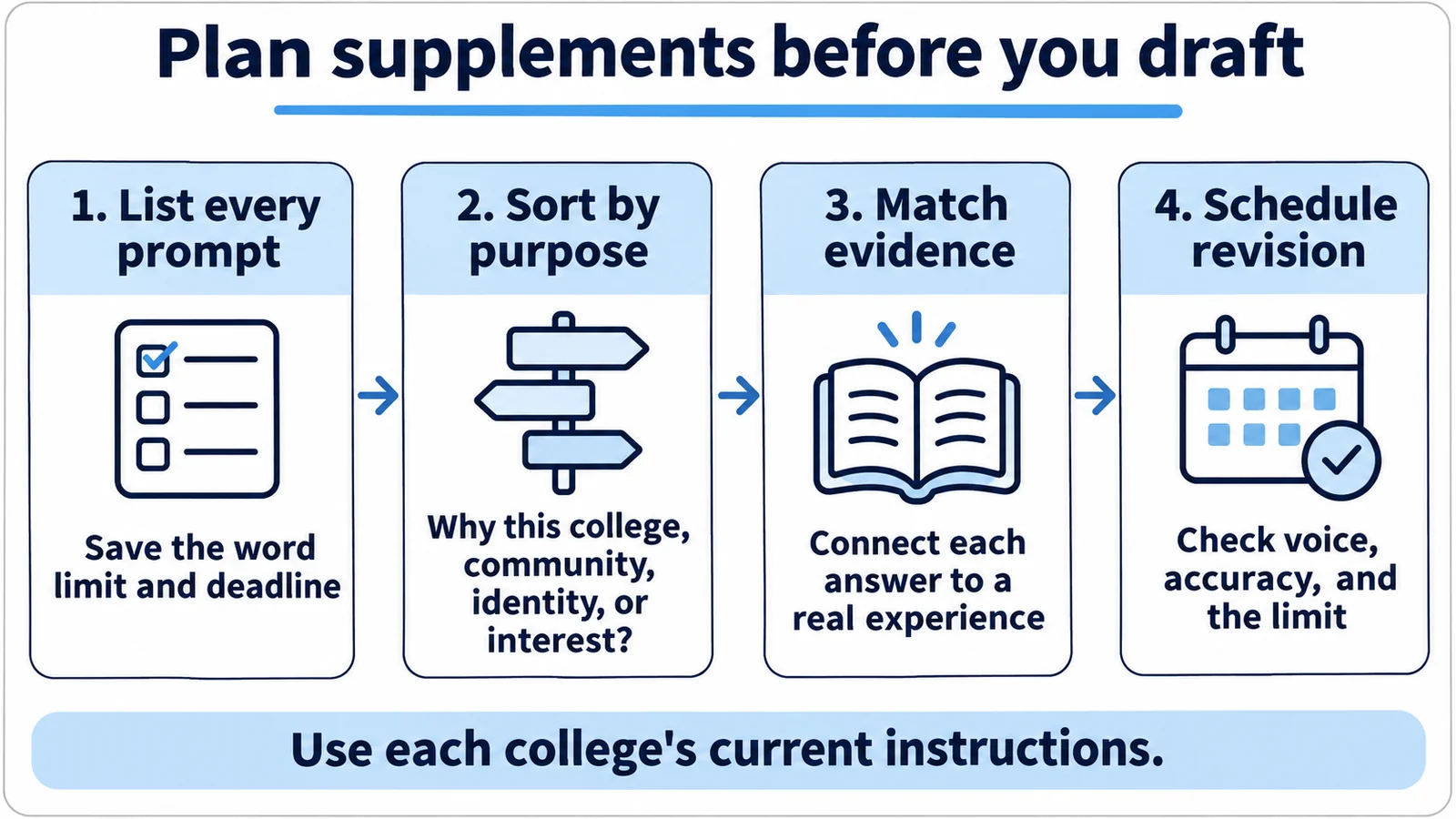
Start in each college's current application portal or official admissions instructions. Record every required and optional writing question, the word or character limit, the deadline, and where the answer must be submitted. Common App's first-year application guide and writing requirements resource are useful starting points, but the college's own instructions control when details differ.
Use one row per prompt. A useful tracker might include:
- College and application plan
- Exact prompt, copied without paraphrasing
- Word or character limit
- Required, optional, or conditional status
- Submission location
- First-draft and revision dates
- Link to the official instructions
Do not assume that a college's supplemental questions will appear in the same place as its personal essay. Some prompts live in the college-specific questions, while others appear in a separate writing supplement or applicant portal. Check the current instructions before you begin drafting.
Sort prompts by what they need from you
After you collect the prompts, group them by purpose. This makes repeated work visible without encouraging you to reuse one answer everywhere.
Why this college or why this program?
These questions ask you to connect a real interest or goal with specific details about the college. Research the academic department, course catalog, program pages, student organizations, or community opportunities that are current and relevant to you. Do not list a college's features just to prove that you visited its website. Explain why one or two details matter to your next step.
Community, identity, or perspective
These prompts may ask how an experience shaped you or how you would contribute to a community. Start with something you can describe honestly: a responsibility, place, relationship, tradition, question, or group that has influenced how you see the world. You do not need the most dramatic story. You need a clear perspective and enough detail for the reader to understand it.
Academic interest or intellectual curiosity
Name the question or problem that holds your attention, then show how you have pursued it. A class, project, job, conversation, book, experiment, or community experience can all be useful evidence. Focus on what you noticed and what you did next—not only on the subject label.
Short answers and quick takes
Short responses still need planning. Their small word limits make precise choices more important, not less. Write the answer in plain language first, then trim repetition and broad claims. Keep a separate note of details you have already used so the full application shows range.
Match each prompt to evidence from your life
Make a small idea bank before drafting. For each possible topic, write three notes:
- The moment or experience: What happened, and what was your role?
- The meaning: What did you learn, question, change, or begin to value?
- The next connection: Why does this matter for the prompt or this college?
For example, a student who organized transportation for a neighborhood volunteer project might use that experience for a community prompt, an answer about problem-solving, or a response about public service. The best choice depends on the exact question and what the rest of the application already shows. Do not force one story into every category.
Keep a “used elsewhere” column in your tracker. If three responses all describe the same club, ask whether one could reveal a different part of you—or whether another experience would give the application more range.
Research colleges without writing a brochure
For college-specific responses, use official pages and save the URL beside your notes. Verify course names, program requirements, faculty roles, student opportunities, and deadlines shortly before submitting because details can change.
Yale's essay guidance encourages applicants to write about something meaningful, share a unique perspective, and use their own voice. Its current prompts also show why you should read the exact question rather than rely on a generic “Why us?” formula. Princeton's application advice likewise emphasizes that the writing should be the applicant's own work.
Use this research note format:
- Official detail: What does the page actually say?
- Personal connection: Why does this detail matter to you?
- Open question: What still needs confirmation?
That third line prevents confident-sounding guesses from entering your draft. If a detail cannot be verified, remove it or describe the broader opportunity accurately.

Turn the map into a writing schedule
Give each response its own small sequence instead of scheduling “write supplements” as one giant task:
- Day 1: Read the prompt aloud, record the task words, and choose two or three possible experiences.
- Day 2: Research only the official college details you need and save the links.
- Day 3: Make a rough outline with one main idea, concrete evidence, and a clear ending.
- Day 4: Draft quickly without polishing every sentence.
- Day 5: Check whether the draft answers this prompt and could not be sent unchanged to another college.
- Day 6: Revise for specificity, voice, accuracy, and the word limit.
- Day 7: Ask a trusted reader for feedback on clarity, then make the final choices yourself.
Leave buffer time for portal questions, recommendation materials, and technical submission steps. A draft that is finished the night before a deadline is not finished until you have checked where it goes and how it must be formatted.
Use a final review checklist
Before you submit, confirm:
- I answered the exact prompt and stayed within its limit.
- I checked the college's current official instructions.
- My examples are concrete and accurate.
- I explained what the details mean to me instead of listing them.
- This response adds something that the rest of my application does not already repeat.
- The language sounds like me after reading it aloud.
- A reader checked clarity without taking over the writing.
- I saved the final version in the correct application location.
Tools like Essay Studio can help you organize prompts and plan revisions, but the experiences, decisions, and final voice should remain yours.
Keep the process small and specific
Supplemental essays become easier to manage when each one has a purpose, a source list, a few possible experiences, and a next action. Start by building the tracker today. Then choose one prompt, verify its current instructions, and make a rough outline before opening the draft.