How to Write the Common App Activities Section
Turn your real commitments into clear, specific Common App activity entries without forcing your experiences into a résumé template.
If your activities list is a pile of club names, job titles, and half-remembered dates, do not start by squeezing everything into the form. Start by rebuilding the story behind each commitment: what you did, how long you did it, and why it mattered.
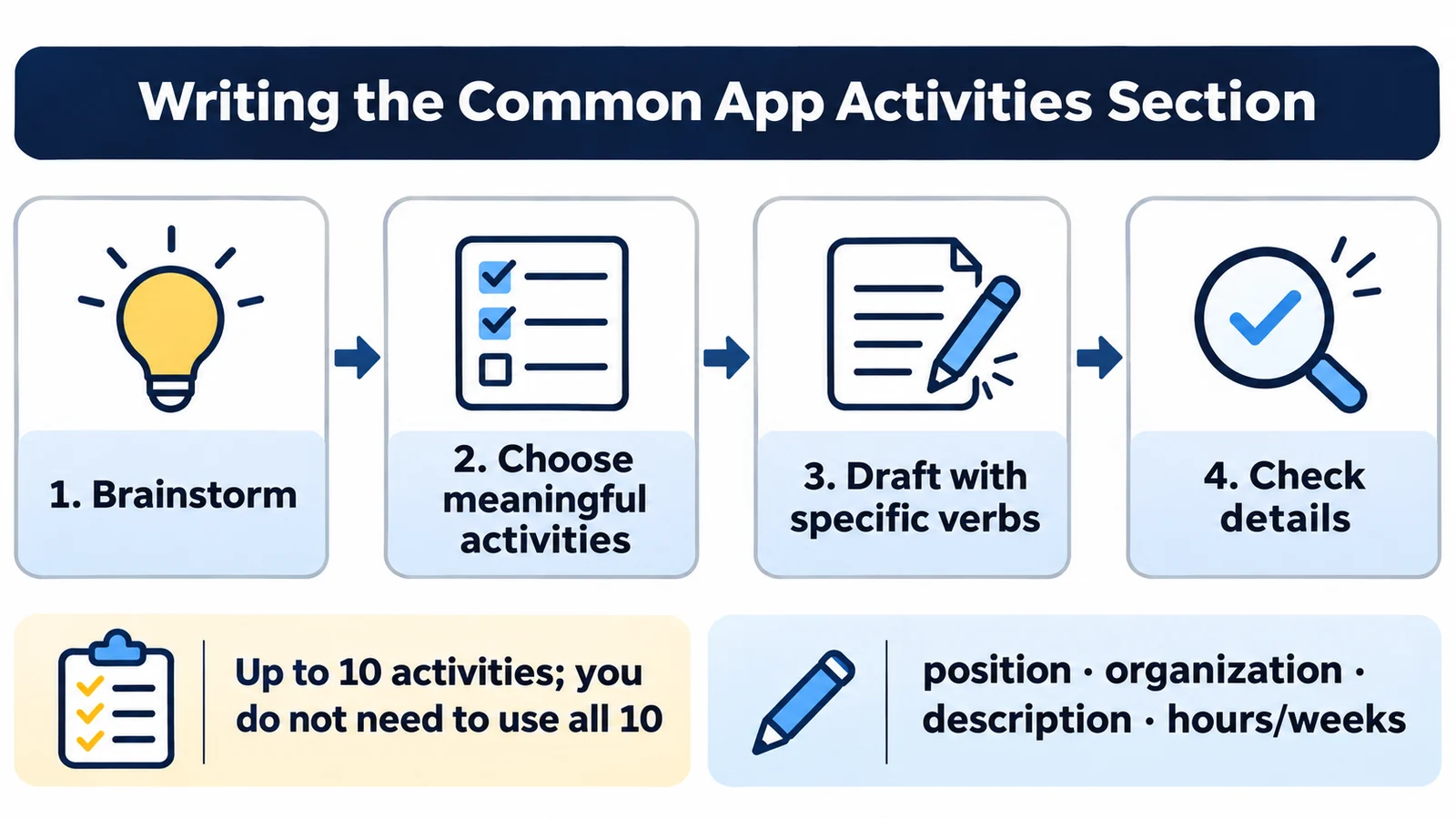
The Common App Activities section gives colleges context about your life outside the classroom. The official Common App activities guide says students can include meaningful experiences such as family responsibilities, work, internships, volunteering, hobbies, and sports. It also says you can add up to 10 activities, but you do not need to use all 10.
Start with a wide brainstorm
Before deciding what “counts,” make a private list of the ways you spend meaningful time. Include commitments that happen at home, at work, online, or in your community—not only activities with official meetings and matching T-shirts.
Try these categories:
- School clubs, academic teams, arts groups, and student leadership
- Sports, music, theater, dance, and creative practice
- Paid work, internships, or helping with a family business
- Volunteering, faith communities, and neighborhood projects
- Caring for siblings, supporting relatives, or managing household responsibilities
- Independent hobbies, projects, caregiving, or other sustained interests
Write down the ordinary details while they are fresh. Maybe you opened the shop before school, translated for relatives, repaired bicycles for neighbors, practiced guitar on your own, or handled meals while a parent worked. Those details show responsibility more clearly than a vague label.
Do not inflate a short experience into a long-term commitment. Accuracy builds a more believable application and makes the later form easier to complete.
Choose the activities that tell the clearest story
You have limited room, but the answer is not to choose only the most prestigious-sounding experiences. Choose the activities that help a reader understand your interests, responsibilities, growth, or contribution.
For each brainstormed activity, ask:
- Did I spend meaningful time or energy on this?
- Did I have a responsibility, role, or contribution I can describe?
- Can I support the dates, hours, weeks, and organization details with a reasonable record?
- Does this add useful context that is not already obvious elsewhere in my application?
If an activity is important but does not fit neatly into a club category, that is not a reason to omit it. Common App specifically points students toward experiences outside the classroom. A job or family responsibility can show commitment just as directly as an organized school activity.
Draft with specific verbs
The best short descriptions make the reader see your contribution quickly. Begin with a strong verb, name the work, and add a concrete result or responsibility when you have one.
Instead of:
Member of environmental club; attended meetings and helped with events.
Try:
Organized campus recycling drives, recruited volunteers, and presented waste-reduction ideas to student council.
The second version gives the reader actions to picture. It does not claim an impressive outcome that you cannot verify; it simply replaces a broad label with what the student actually did.
Useful verbs include organized, coached, translated, built, researched, designed, managed, mentored, performed, served, cared for, and raised. Choose the verb that matches your real role. “Led” should mean you led something; “supported” is stronger than an exaggerated title when support was your contribution.
Common App’s activity fields have character limits, so draft long first and edit second. The older official activities resource describes separate spaces for position or leadership, organization name, and activity details. It also explains that hours per week and weeks per year are reported elsewhere. Treat each field as a chance to add a different piece of information rather than repeating the same sentence three times.
Make every field do a job
Use this simple division of labor:
- Position or leadership: Your role in a few words
- Organization name: The group, employer, team, household, or community setting
- Activity details: The work you performed, people you served, skills you used, or responsibility you carried
- Time commitment: Your best accurate estimate for hours per week and weeks per year
For example, a student who helps care for younger siblings might write a position such as “Family caregiver,” use “Home and family” as the organization context, and describe preparing meals, coordinating school pickup, and helping with homework. The point is not to make a family responsibility sound like a formal organization. The point is to explain the responsibility clearly.
Keep your estimates consistent with reality. If your hours changed by season, think through a reasonable average and use the additional explanation space only when the variation needs context. Common App’s guidance also indicates that students can use the Additional Information question when they need more room to explain an activity or experience. That space should clarify meaningful context, not become a second résumé.
Check your list before you submit
Use this final review:
- Every activity is something I actually did or am genuinely committed to doing.
- The entries include work, responsibilities, or independent interests when they are meaningful to my story.
- The most important activities appear first for a reason I can explain.
- Each description uses specific actions instead of generic praise.
- My role, organization, dates, hours, and weeks agree with my records.
- I did not repeat the same accomplishment across multiple entries.
- I did not use all 10 slots just to fill space.
- The wording sounds like me and does not promise outcomes I cannot prove.
Ask a counselor, teacher, or trusted adult to check for clarity and missing context. They can help you notice when an abbreviation is confusing or when an entry leaves out the part that shows your responsibility. They should not turn your experiences into someone else’s voice.
Keep the entry honest and useful
An activities section is not a contest to see who can collect the most titles. It is a compact record of how you spend time, what you care about, and where you take responsibility. A focused list of real commitments is more useful than a padded list that you cannot explain.
Tools like ColleGPT can help you brainstorm categories, identify missing details, or tighten a draft while you remain responsible for the facts and final wording. Before submitting, compare every change with your own records and the current instructions inside your Common App account.

Your next step is simple: set a 20-minute timer and make the wide brainstorm before opening the application form. Then choose the experiences that best show your commitments, draft each entry with specific verbs, and verify the details one field at a time.