Large College vs. Small College: Which Campus Size Fits You?
Compare large and small colleges by academics, community, support, cost, and daily routine before you build your college list.
If you are choosing between a university with thousands of students and a college where you might recognize most faces, do not treat size as a personality test. Both settings can offer strong academics and a real sense of belonging. The better question is how each campus would shape your classes, choices, relationships, and routine.
What “Large” and “Small” Actually Mean
There is no single national cutoff that makes a college large or small in every student's experience. A school may feel large because it has a big undergraduate population, multiple colleges within one university, a spread-out campus, or a wide range of programs. Another school may have more students overall but feel smaller because first-year students live in a defined community or because your major is housed in a close department.
Use size as a starting point, not a final label. The College Scorecard lets students compare institutions using information such as enrollment size, location, costs, and outcomes. Its guide also recommends searching based on what matters to you, reviewing a school profile, and comparing several schools rather than relying on one number.
When you compare colleges, look separately at:
- Undergraduate enrollment, not only total enrollment
- The size of the department or program you may enter
- Class formats in introductory and advanced courses
- How far students travel between residence halls, classes, dining, and activities
- Whether the campus is residential, commuter-heavy, or a mix
Large College: More Choice, More Navigation
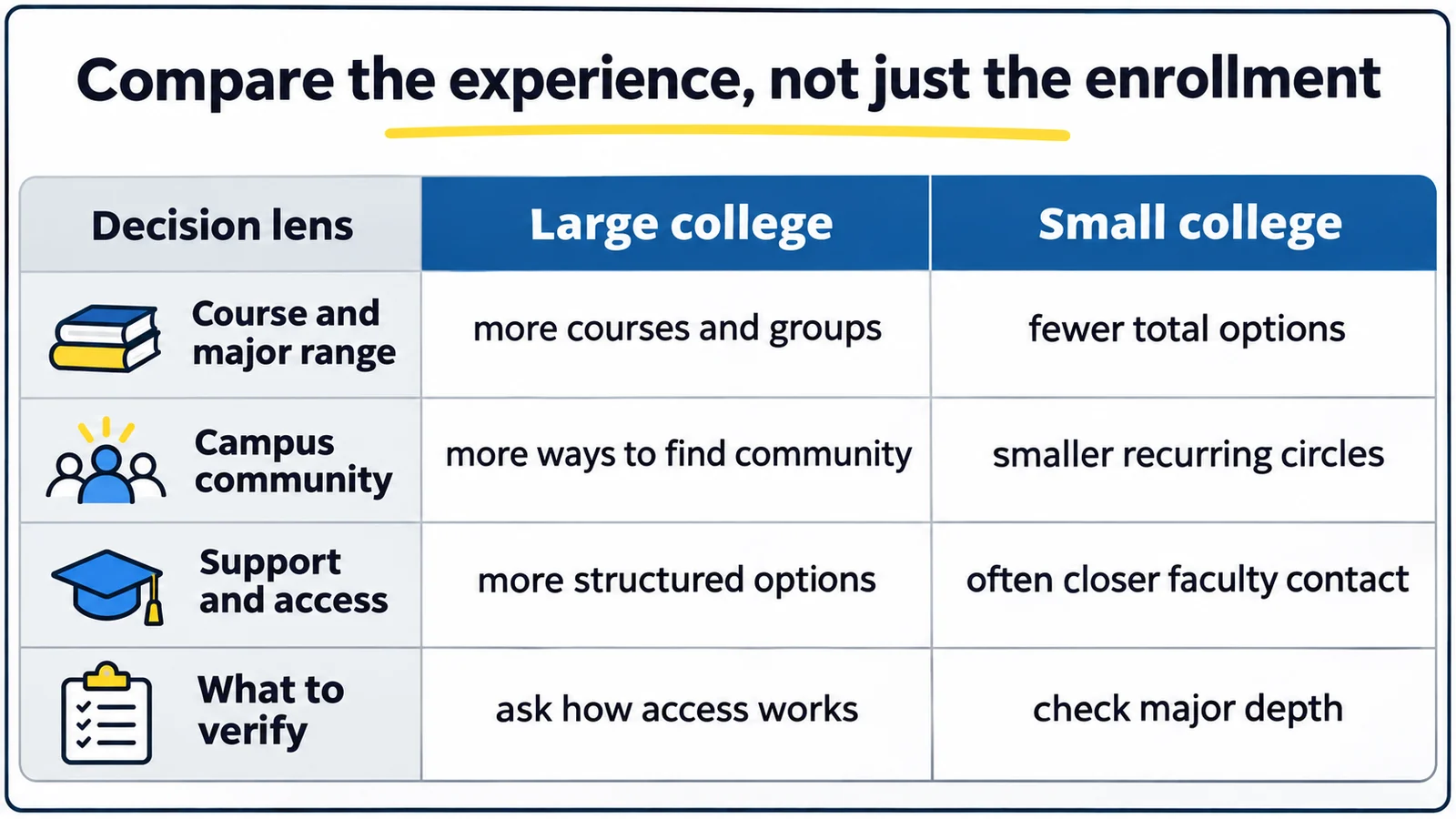
A large college often gives you more ways to build an academic and social path. You may find a longer course catalog, many student organizations, several campus newspapers or performance groups, and specialized facilities. If you are undecided, that range can make it easier to explore more than one subject before choosing a direction.
Large campuses can also offer multiple versions of the same experience. There may be a large lecture for a foundational course, a smaller discussion section, a residence-hall community, and a major-specific club. You are not limited to one circle of people or one way to participate.
The tradeoff is that access may require initiative. A popular class may have registration rules or a waitlist. An office may serve a large number of students, so you may need to make appointments early and ask specific questions. A campus organization can be welcoming, but you may have to attend several meetings before you find your people.
Ask a large college:
- How do students get into required courses for their major?
- What is the usual format for introductory classes and their discussion sections?
- Which advising, tutoring, and mental-health services are available to undergraduates?
- How do students find smaller communities within the larger campus?
- What does a normal week look like for transportation and time between classes?
Small College: A Tighter Community, A Smaller Menu
A small college may make it easier to see familiar classmates, build relationships with professors, and participate in discussions. Kenyon College, for example, publishes its enrollment and class-size statistics openly; its official numbers show a small undergraduate community and average class sizes in the mid-teens. That is one example, not a promise about every small college.
Smaller schools may also make it easier to join a club, ask a professor about research, or take on a campus role without competing with thousands of students. A close community can feel supportive if you like recurring routines and knowing the people around you.
The tradeoff is that the course catalog and activity list may be narrower. A small college can have excellent depth in its strongest departments, but you should check whether it offers your intended major, the courses you need, and useful alternatives if your interests change. A small campus can also feel socially concentrated: if you want a new circle, you may have fewer unrelated groups to try.
Ask a small college:
- How many courses are available in my intended major each term?
- Can students take classes across departments or at partner institutions?
- How often do students work directly with faculty on research or projects?
- What happens if a required course is full or offered only once a year?
- Which communities exist for students whose interests do not fit the most visible campus groups?
Compare the Parts of College You Will Actually Use
The word “opportunity” can hide important details. A large university may list hundreds of clubs, but the useful question is whether the groups connected to your interests meet at a time you can attend. A small college may list fewer programs, but you might have a realistic path to lead one or work closely with a faculty adviser.
Compare these five areas for every school:
- Academic range: List the majors, minors, concentrations, introductory courses, and advanced electives you would realistically consider.
- Access: Ask how students register for required courses, meet with advisers, use tutoring, and reach faculty outside class.
- Community: Identify residence-hall structures, clubs, traditions, identity-based communities, and places where you could meet people repeatedly.
- Daily logistics: Estimate walking time, transportation, dining options, study spaces, and how often you would leave campus.
- Financial fit: Review the official cost of attendance, financial aid pages, and net price information. A campus that fits your budget is part of campus fit.
Do not infer the whole experience from a college's size. A large school may create small communities through honors programs, living-learning communities, or a focused major. A small school may still offer large lectures, competitive registration, or a limited number of advanced courses.
Use Official College Pages to Test Your Assumptions
College websites are useful when you want details that a national comparison tool cannot provide. Look for the undergraduate admissions facts page, academic department pages, course catalogs, student-support services, housing information, and a current cost-of-attendance page.
For an example of the detail a large university may publish, the University of Michigan's undergraduate facts and figures describes its schools and colleges, degree programs, student organizations, learning communities, and research opportunities. For a smaller-college example, Kenyon's official “In Numbers” page describes its student community, academic offerings, research, housing, and organizations.
These pages are examples of how to research, not evidence that one institution is right for you. Check the date of every figure, and ask an admissions or academic office when a page does not answer your question. During a visit or virtual session, ask a student to describe an ordinary Tuesday rather than only the most impressive campus tradition.
A Five-Minute Decision Guide
For each college on your list, finish these sentences with evidence:
- I would choose this size because I want...
- I might struggle with this size if...
- My intended major has these course options...
- My easiest path to community would be...
- My biggest unanswered question is...
Then mark each school with one of three labels:
- Strong fit to investigate: Your preferences and the school's evidence line up.
- Possible fit with questions: The school looks promising, but you need answers about access, cost, or daily life.
- Not a fit right now: The size creates a clear problem that you do not want to solve.
Tools like UniMatch can help you organize comparisons by major, location, cost, and fit, but keep the underlying facts tied to current official college pages.
Choose the Environment You Can Use Well
Large and small colleges both have advantages and compromises. A larger campus can give you breadth and many ways to start over; a smaller one can give you continuity and a tighter network. Neither guarantees better teaching, easier admission, stronger friendships, or a more affordable degree.
Choose two large and two small colleges to investigate. For each one, verify your major, compare the financial information, ask how students access support, and picture an ordinary week. The right size is the one whose opportunities and routines match how you want to learn and live.