How to Improve Digital SAT Reading and Writing
Use a focused review loop to improve Digital SAT Reading and Writing skills, practice official questions, and learn from every missed answer.
If your Digital SAT Reading and Writing practice feels random, stop collecting missed questions and start sorting them. Improvement comes from knowing which skill a question tested, why your answer failed, and what you will do differently on the next question.
College Board organizes this section into four domains: Information and Ideas, Craft and Structure, Expression of Ideas, and Standard English Conventions. A useful study plan touches all four, but it should spend extra time on the patterns your own work reveals.
Start With a Realistic Baseline
Take an official full-length digital practice test in Bluebook before changing your study routine. The practice environment gives you a more useful starting point than a handful of untimed questions because you have to read, decide, and use the digital tools within the test format. College Board says completed Bluebook practice tests can be reviewed in My Practice, including scores, questions, and rationales.
Do not treat one practice score as a prediction of your final score. Use it as a diagnostic. For each missed or uncertain question, record:
- The content domain or skill, if you can identify it
- Whether you misunderstood the passage, the question, or an answer choice
- Whether time pressure or careless reading affected your decision
- The reason the correct answer works
Include questions you guessed correctly. A correct guess can hide a skill you have not yet mastered, and it deserves review before it becomes a repeated mistake.
Learn What Each Question Is Asking
The section uses short passages or passage pairs followed by a single multiple-choice question. College Board's official Reading and Writing overview describes the four domains and the skills behind them. Use those domains as labels for your review log.
Information and Ideas questions ask you to understand, interpret, or evaluate information. Before looking at the choices, state what the passage actually claims. For an inference question, choose the conclusion most directly supported by the text, not the one that sounds generally true.
Craft and Structure questions may test words in context, text structure and purpose, or connections between passages. Read the surrounding sentence and ask what the word or section is doing in that specific passage. A familiar definition may not be the meaning that fits the author's use.
Expression of Ideas questions focus on making a passage clearer or more effective. Identify the stated goal first: introduce an example, create a contrast, summarize a point, or connect evidence to a claim. The best choice serves that goal without adding information the notes do not support.
Standard English Conventions questions test sentence structure, usage, and punctuation. Read the whole sentence, not just the underlined portion. Check whether the choices change the boundaries between independent and dependent clauses, then check agreement, verb form, and punctuation.
Use a Four-Step Review Loop
The most productive practice session is not the one with the largest question count. It is the one that turns a missed question into a repeatable decision process.
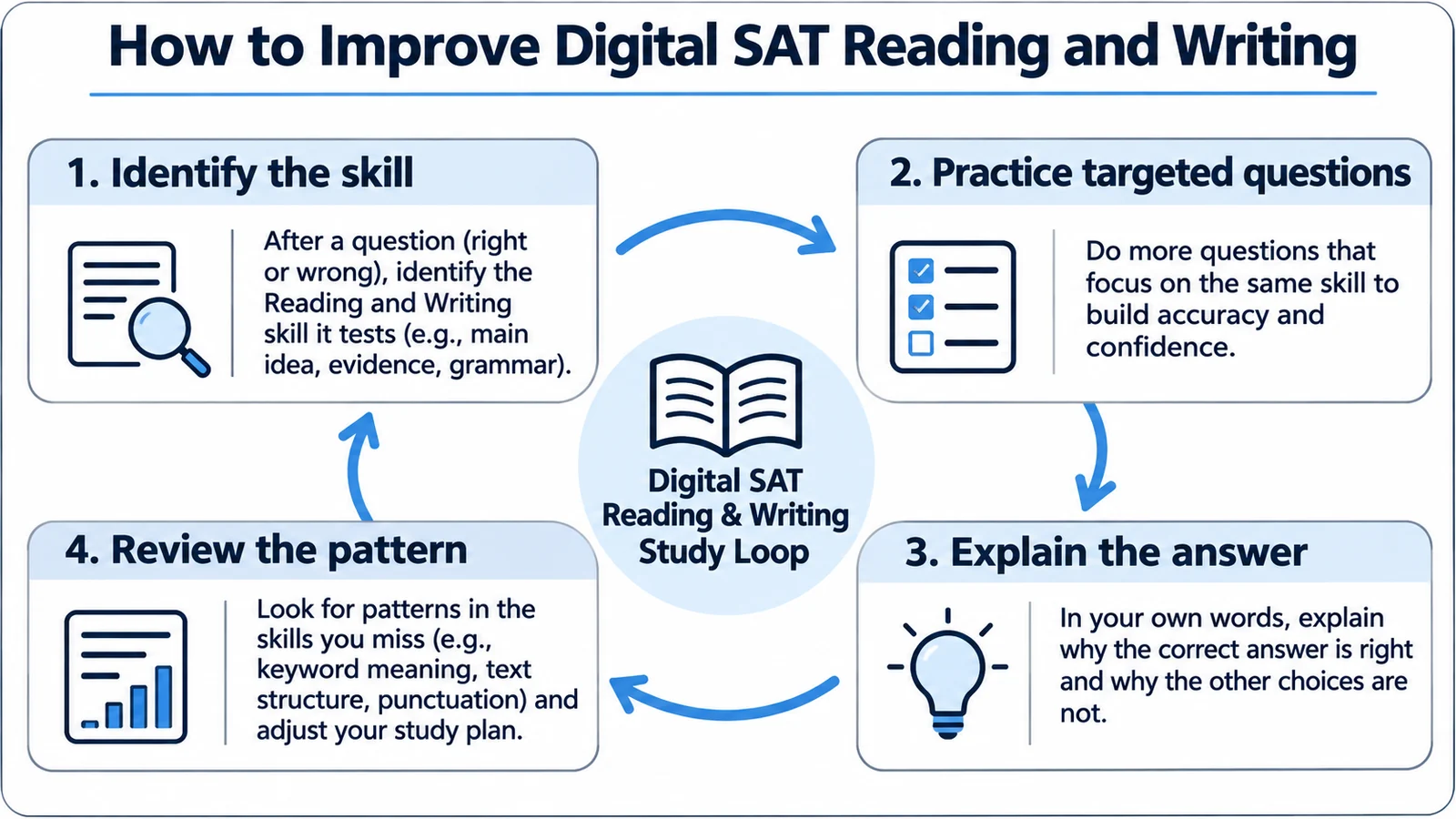
Use this loop after a short set of official questions:
- Identify the skill. Label the question with a domain and a more specific task, such as transition, central idea, words in context, or punctuation.
- Practice targeted questions. Use the College Board Student Question Bank to filter by section, domain, skill, and difficulty. Start with one priority instead of mixing every skill together.
- Explain the answer. Write one or two sentences explaining why the correct answer fits and why your chosen answer does not. If you cannot explain it, you are not finished reviewing it.
- Review the pattern. After several sessions, look for repeated causes: missing a contrast word, choosing an answer that goes beyond the passage, or skipping a clause boundary.
Keep the explanation in your own words. Copying a rationale may show that you read it, but explaining the decision shows whether you can use the idea on a new question.
Practice Reading Without Chasing Speed
Reading faster is not a complete strategy. The goal is to make accurate decisions with the time available. Start each passage by identifying its job: Is it presenting a claim, contrasting viewpoints, describing a result, or explaining a process? Then read for the information needed by the question.
Pay attention to small words that change relationships. Words such as however, although, therefore, and for example can signal contrast, qualification, cause, or evidence. In a main-idea question, these relationships may matter more than a single interesting detail.
For evidence and inference questions, return to the passage. Do not rely on what you remember from a quick first read. Cross out choices that introduce a new claim, reverse the passage's meaning, or use an absolute word when the passage is qualified.
For paired passages, summarize each author's position in a few words before comparing them. The question usually asks about a relationship between the passages, not whether one author is generally more persuasive.
Make Grammar Decisions Systematic
Grammar improvement works best when you use a sequence instead of guessing by sound. When punctuation or sentence structure is tested:
- Read the sentence without looking at the choices if possible.
- Find the subject and verb in each clause.
- Decide whether the clauses can stand alone or whether one depends on the other.
- Select the punctuation or structure that creates the intended relationship.
- Read the completed sentence for meaning and standard usage.
For transitions, read the sentence before and after the blank. Name the relationship—contrast, continuation, cause, or example—before comparing answer choices. For rhetorical synthesis questions, use the student's notes and the stated goal as boundaries. An answer can be factually true and still fail because it does not accomplish the requested purpose.
Use Timing as a Review Signal
The standard Reading and Writing section has two separately timed modules. College Board's section specifications list 25 operational questions and 2 pretest questions in each module, with 32 minutes per module. Your approved accommodations may change the timing, so follow the setup provided by your school or College Board.
During practice, record when time affected an answer. A slow question is not automatically a content weakness. If you understood the passage but spent too long comparing two choices, practice a decision rule. If you repeatedly reread because you missed the author's claim, strengthen comprehension before adding more timed sets.
In Bluebook, practice the tools you expect to use, including highlighting, notes, flagging, and the option eliminator. The goal is not to click every tool. It is to make navigation familiar enough that it supports your reasoning instead of interrupting it.
Build a Weekly Study Rhythm
Try this repeatable schedule, adjusting the number of questions to fit your available time:
- Session 1: Review one domain and complete a small targeted set.
- Session 2: Review every question from Session 1, including correct guesses, and write explanations.
- Session 3: Practice a second domain and include a short timed set.
- Session 4: Revisit your error log and choose the next week's priority.
Every week or two, complete a longer practice block to check whether targeted work transfers to mixed questions. Keep the same error categories so that your notes show trends rather than becoming a pile of disconnected comments.
Tools like Test Prep in The College App can help you organize focused practice, but official College Board practice materials should remain your reference for the current test experience and question types.
Keep the Next Session Concrete
Do not end a study session with “study Reading and Writing more.” End it with a specific action: complete eight Expression of Ideas questions, explain every answer, and review whether transition errors came from missing the relationship between sentences.

The next time you miss a question, treat it as data. Identify the skill, practice a focused group, explain the decision, and look for the pattern that should shape your next session. That loop gives your preparation direction—and makes each practice question more useful than the last.