How to Review a Digital SAT Practice Test
Turn a Digital SAT practice score into a study plan by sorting mistakes, explaining answers, and practicing the skills you need most.
If you finish a Digital SAT practice test and only write down the score, you are leaving the most useful information untouched. The real review starts with the questions you missed, guessed on, or answered slowly.
College Board's My Practice dashboard lets you see your practice-test questions, the answer you selected, the correct answer, and an explanation. Use those details to build a short list of skills to practice—not just a list of letters you got wrong.
Give Your Practice Test a Purpose
Before you begin, decide what you want the review session to answer. For example:
- Which question types caused repeated errors?
- Did I misunderstand the content, the question, or an answer choice?
- Did time pressure change my decisions?
- What should I practice before my next timed set?
This keeps review from becoming a second attempt at the entire test. You do not need to reread every question for the same amount of time. Start with missed questions, then add questions you guessed on or solved with an unusual amount of effort.
If you took the test in Bluebook, return to the practice results in My Practice. College Board's Bluebook practice guidance explains that Score Details can show every question and provide a Review option with answer explanations. Use the official explanation as evidence, but write your own summary of the lesson.
Sort Every Question Into a Cause
Create a review log with one row for each missed or uncertain question. You can use a notebook, spreadsheet, or a simple document. Record:
- Section and skill: Note whether the question came from Reading and Writing or Math, then identify the closest skill or content area.
- Your answer: Write the choice you selected, including correct guesses.
- What happened: Name the cause, such as misunderstood the passage, forgot a rule, misread a graph, rushed, or eliminated the right answer.
- The lesson: Explain what evidence supports the correct answer and what made your choice tempting.
- Next action: Choose a small practice task that targets the same decision.
Avoid labeling everything as a “careless mistake.” That label ends the investigation too early. If you misread a negative word, record that. If you used a familiar formula in the wrong situation, record that instead. A useful category tells you what to do next.
Use the Four-Step Review Loop
Review is most effective when each error leads to a specific action. Work through the same loop for every important question, then look for patterns across the test.
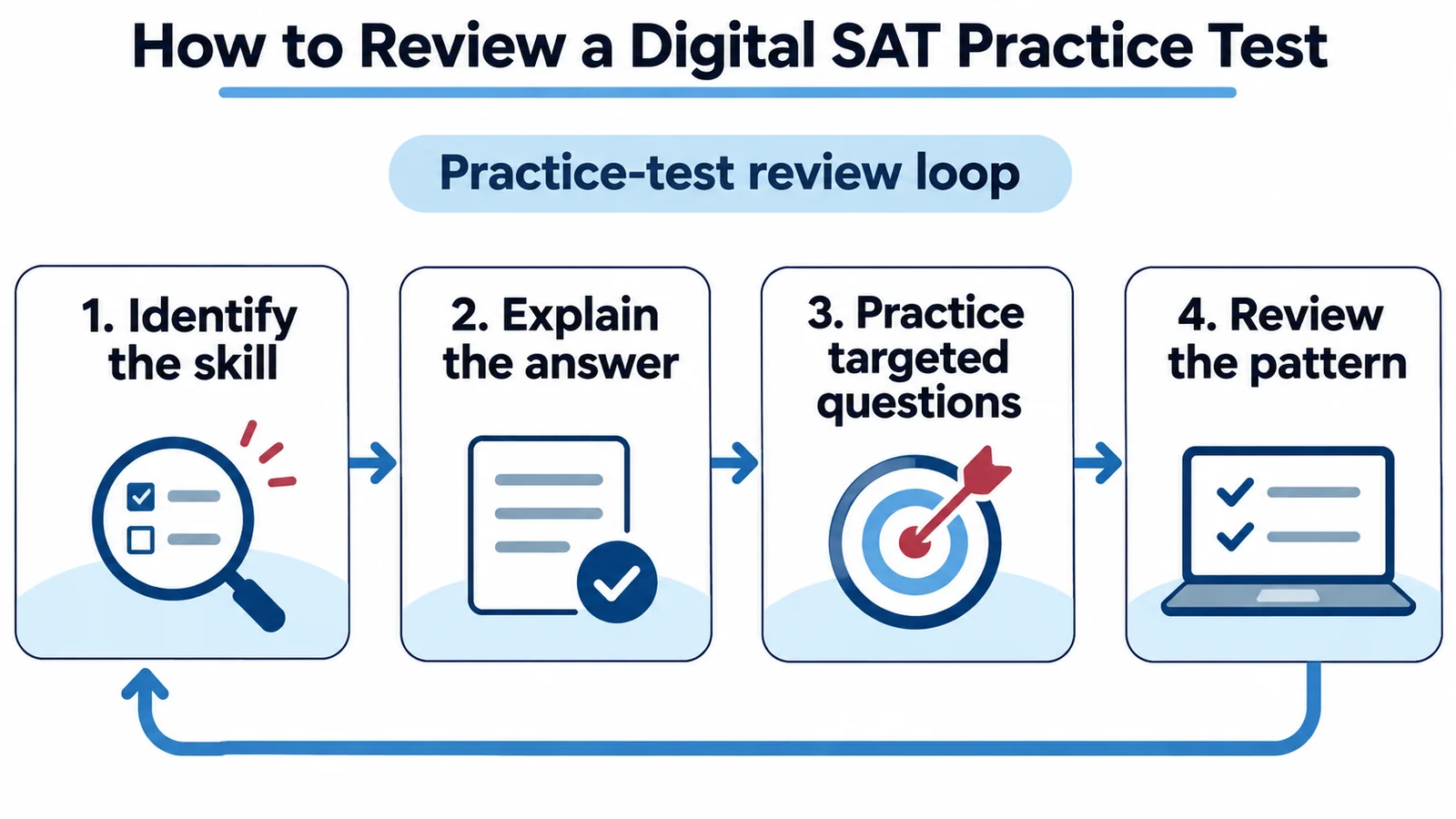
1. Identify the skill
Name what the question was testing before you read the explanation. In Reading and Writing, that might be a transition, a central idea, a word in context, or sentence boundaries. In Math, it might be a linear equation, a function, a percentage, or interpreting data.
If you cannot identify the skill, that is useful information too. Read the question and the explanation again, then describe the task in plain language. “Find the value that makes the two expressions equal” is more useful than “Math question 18.”
2. Explain the answer
First, explain why the correct choice works. Then explain why your choice fails. This second part matters because a wrong answer is often designed to match a predictable misunderstanding.
For a Reading and Writing question, point to the phrase or relationship in the passage that supports the answer. For Math, write the step where your reasoning changed direction. If you guessed correctly, explain the reasoning you should have used instead of treating the result as proof that your approach was solid.
3. Practice targeted questions
Once you know the skill, choose a small group of similar questions. College Board's Student Question Bank lets students filter official questions by section, domain, skill, and difficulty. Use one or two filters at a time so you can tell whether the practice is helping.
Do not immediately repeat a full-length test. A focused set gives you more chances to notice the same decision, correct it, and explain it while the original mistake is still fresh.
4. Review the pattern
After several questions, return to your log. Look for a repeated cause rather than counting only the number wrong. You might notice that you regularly:
- Choose a transition before checking the relationship between sentences
- Select an answer that is true in general but not supported by the passage
- Skip a condition in a word problem
- Change a correct answer because you distrust your first reading
Turn the pattern into a rule you can test in your next session. For example: “For transitions, name the relationship before reading the choices.” A short rule is easier to use under time pressure than a page of general advice.
Review Timing Separately From Content
A wrong answer does not always mean you lack the underlying skill. Mark whether you knew what to do but ran out of time, made a rushed choice, or spent too long comparing two plausible answers.
If timing was the main issue, practice the decision that slowed you down. For a transition question, read the sentences around the blank and name the relationship before looking at the choices. For a math question, write down the given information before choosing a method. The goal is a repeatable process, not simply moving faster.
Bluebook practice tests are designed to help you become familiar with the digital testing experience. Practice with the tools you expect to use, but do not turn every tool into a habit. Highlighting, notes, flagging, or answer elimination should support your reasoning rather than replace it.
Build Your Next Study Session
End the review by choosing a small, measurable assignment. A useful plan might look like this:
- Priority skill: one repeated error category from the log
- Practice set: a focused group of official questions
- Review rule: the sentence or checklist item you will use on every question
- Evidence: a short explanation for each answer, including correct guesses
- Follow-up: one mixed or timed set later to see whether the skill transfers
Tools like Test Prep in The College App can help you organize practice around a score goal and study plan, while College Board materials remain the reference for official practice questions and explanations.

Make the Next Test More Informative
Your next practice test should give you better information because you changed what you do between tests. Keep the same error categories, compare the patterns, and note which rules you can apply without prompting.
The goal of reviewing a Digital SAT practice test is not to prove that you made mistakes. It is to make each mistake specific enough to guide your next decision. Identify the skill, explain the answer, practice a focused group, and review the pattern before you take another full test.